* Hop quiz
* Australian harvest report
* New Zealand harvest report
* A message from Michigan
* UK-grown Hersbrucker?
* Nebraska gets a hop of its own
Welcome to Volume 10, No. 1. There was a time when all hops were lager hops. But then along came Cascade and Simcoe and Thora that didn’t quite fit. Now, because recently minted styles such as West Coast Pilsner and Hoppy Lager may include new wave hops such as Mosaic and Nelson Sauvin once again all hops are lager hops. But is this what brewers are talking about when they say “lager hops?”
“When we look at craft lager, we started with more European inspiration,” Jack Hendler, co-author of “Modern Lager Beer” said a while back. “And the question is, where are we going now? I think you’re starting to see changes as to how Americans on the craft side are brewing lager, where they’re getting inspiration from, and how we’re trying to create our own new American lager styles in the U.S.”
Hops will play a part, rather obviously in some beers and not so much in others. I don’t have a short answer for how, and honestly two stories I wrote for Brewing Industry Guide may raise as many questions for brewers as they answer. I’ll probably have more to write here, maybe after the next harvest. Meanwhile, those stories have posted online (behind a paywall) and soon will be in print.
The links:
HOP QUIZ
What are counter culture hops?
AUSTRALIA TRIMS PRODUCTION
Reacting to diminishing worldwide demand for hops, Hop Products Australia continued to reduce acreage for 2026. Farmers strung 8.3% fewer acres and produced 11.7% fewer hops. They harvested almost 2.9 million pounds. For perspective, that’s equal to 3.4% of the US crop or to the amount of Mosaic farmers in the Yakima Valley harvested.
“We’ve continued to right size production, which has positioned us well as the market begins to find its balance” HPA CEO Owen Johnston said for a press release. “But Luna is the standout story of the year. It exceeded our expectations with unprecedented demand in its debut season. Most of crop 2026 is already contracted, and with the strength of future interest we’re moving quickly to significantly increase supply from crop 2027 onwards.”
HPA harvested about 6,600 pounds of Luna, and her release marks the beginning of a renewed focus on more frequent commercializations from HPA’s breeding program. This year, HPA produced limited pellet lots of five leading experimental hops: HPA-031, HPA050, HPA-065, HPA-3029, and HPA-4029.
Galaxy production shrunk about 38% to 1.2 million pounds, but Vic Secret grew 64% to more than 880,000 pounds and Eclipse 107% to 432,000 pounds.
The press release states, “Impact in beer is expected to remain strong, with favorable conditions through the early summer months supporting the accumulation of key metabolites. This year’s oil content is only slightly below the 5-year average for most proprietary hops.”
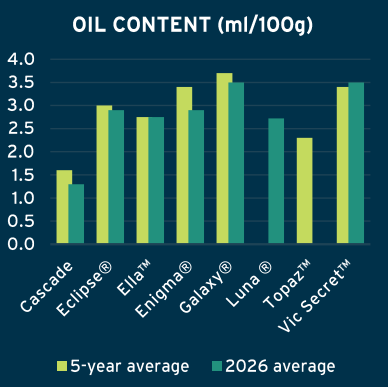
HPA has invested heavily in new facilities and process updates to increase throughput for better harvest window management and improve quality for consistent performance in beer. It is no secret that while many brewers still consider Galaxy one of their darlings, others soured on the hop because of what they saw as quality issues that rose when demand exceeded supply.
“For the past four crop years, we’ve partnered with Haas to implement their Sensory Plus quality system.” said head of breeding & research Dr. Simon Whittock. “Using a combination of human sensory expertise and advanced analytics, we identify and exclude non-true-to-type bales at intake, then apply sensory profiling in our pellet blends to deliver maximum consistency across each variety. So every lot of Galaxy tastes like Galaxy, and every lot of Vic Secret tastes like Vic Secret.”
YIELDS DOWN IN NEW ZEALAND
The NZ Hops harvest reports begins, “Mother Nature definitely challenged us this season starting with record rainfalls and flooding in winter. This contributed to overall yield per hectare being down by over 5% compared to prior years. Luckily, our region was also blessed with plenty of sunshine so overall quality was not impacted—from an aroma perspective the hops were bursting with classic southern hemisphere notes.”
The report does not include information about acreage or production. Much has changed since Hop Queries Vol. 2, No.1 in 2018, when co-operative members grew most of the hops harvested in New Zealand and NZ Hops reported production information about each variety (176,551 kilograms of Nelson Sauvin, compared to 185,010 in 2017; 133,600 kg of Motueka, compared to 142,336 the year before).
Three large farm operations outside of the co-op—Clayton Hops, Freestyle Hops and Hop Revolution—have since joined the industry, and there is no official accounting of New Zealand acreage or production similar to what the USDA does for farms in the Northwest. What is clear is that reflecting worldwide demand, overall acreage shrunk following considerable expansion. Nonetheless, New Zealand hops are much easier to find than in 2018 (when Nelson Sauvin could cost $30 a pound on Lupulin Exchange).
The NZ Hops report serves as a reminder that hops are an agricultural product (a phrase I am surprised nobody has tried to trademark). Superdelic and Nectaron drew strong praise from brewers making in-person selection “for their clarity and impact, while Nelson Sauvin, Motueka and Riwaka required more deliberate selection. Across the board, there was no shortage of quality—only a wider range of choice and a good mix of early, mid and late lots to suit brewer preferences.”
Like HPA, NZ Hops may soon be naming more varieties and has scaled up production of two leading trial hops, NZH-106 and NZH-109. They wouldn’t be the only Kiwi newcomers. Clayton commercialized Rhapzody earlier this year, and although Freestyle’s Manilita has been around a while you may not have heard the name. More American brewers are starting to sing her praises.
A MESSAGE FROM MICHIGAN
As reported here in January, Hop Head Farms has exited the hop business. I can think of nobody better than Michigan Hop Alliance founder Brian Tennis to add perspective. Here’s what he posted last month:
“With official announcement that Hop Head Farms here in Michigan has ceased operations and selling off their remaining assets, I think it’s now appropriate to comment on this story and the state of the Michigan hop industry.
“As some may know, we began farming hops 20 years ago in the village of Omena, on the Leelanau Peninsula. We were one of the pioneers of the modern hop industry in Michigan, along with Empire Hops, the Old Mission Hop Exchange, Hop Head Farms, and eventually MI Local Hops, along with dozens of other farms over the years.
“Through the years we were all fierce competitors, but always wanted to see the entire Michigan hop industry grow and prosper. Jeff (Steinman) from Hop Head Farms and I even formed the Hop Growers of Michigan group to help promote Michigan grown hops.
“We watched our industry grow from a few acres to nearly 1,000 acres statewide. That acreage put us in the top ten hop growing regions on the planet, even though we were dwarfed by the Pacific Northwest and Germany, our acreage was important and we were producing world-class hops.
“Then the Covid pandemic hit and we were never the same. In fact, the global craft scene imploded and hundreds, if not thousands of breweries went out of business. This obviously had a devastating impact on farmers not only in Michigan, but globally.
“As hop merchants who deal with farmers around the globe, we felt the impact from farmers from the Yakima Valley to Nelson in New Zealand. In fact, we are still in survival mode. We are starting to see improvement in sales and a few bright spots here and there. However, the economy and the current global political stability is making it extremely difficult.
“We urge you to support the remaining hop growers here in Michigan and your independent brewery.
“What happened to the Michigan Hop industry is not a reflection on the quality of the product, but hopefully a once in a lifetime market correction.
“I hope to be around for the next wave of Michigan hop growers. We can and still do produce world-class hops, albeit on a currently smaller scale.”
HOP QUIZ ANSWER
This may read a little silly, but think about it. From The Hop Guild newsletter:
“Citra and Mosaic built the modern IPA, but the brewers shaping what comes next aren’t running the same playbook. Counter Culture hops, varieties like Tangier, Nectaron, Zumo and Anchovy, are the rule-breakers. Experimental, intensely aromatic, and bred for brewers who’d rather set the trend than chase it. Loud tropical bombs, weird-in-a-good-way candy notes, and dank pine that lingers. The kind of hops that turn a beer into a conversation.”
HARLEQUIN AND HERSBRUCKER
Laura Hadland talked with Charles Faram technical director Will Rogers to find out what’s being strung in the UK this year. More Harlequin (a great granddaughter of Cascade) is being planted, as well as more Phoenix.
Additional Hersbrucker, a German hop that runs with the “noble” crowd and (geek alert) has polyphenols not found in many other varieties, plants are also going in. A UK-grown “Hersbrucker holds a lot of charm for brewers that want to make, for example, a helles-style lager, but with local ingredients,” Hadland writes. “In its home environment, Hersbrucker has been struggling somewhat. Climate change has seen yields vary wildly, as well as the oil and alpha acid content of the harvested hops being subject to significant variation.”
MARGIE
The hop research program at University of Nebraska-Lincoln has released its first named hop. Breeder Kristina Alas named Margie after her dog, a pit bull-German shepherd mix. “This marks an important milestone for our program, as we are finally in a position to release one of our experimental selections,” Alas said.
Margie is notably pest resistant, has promising yield and doesn’t wilt in Nebraska’s high heat and humidity. After years of vigorous testing, Margie proved successful enough to be featured in Corn Coast Brewing’s Gene-ius Selection beer.