* Strung for harvest
* Hop quiz
* Widening the gene pool
Welcome to Volume 10, No. 2. And we’re on the move . . .
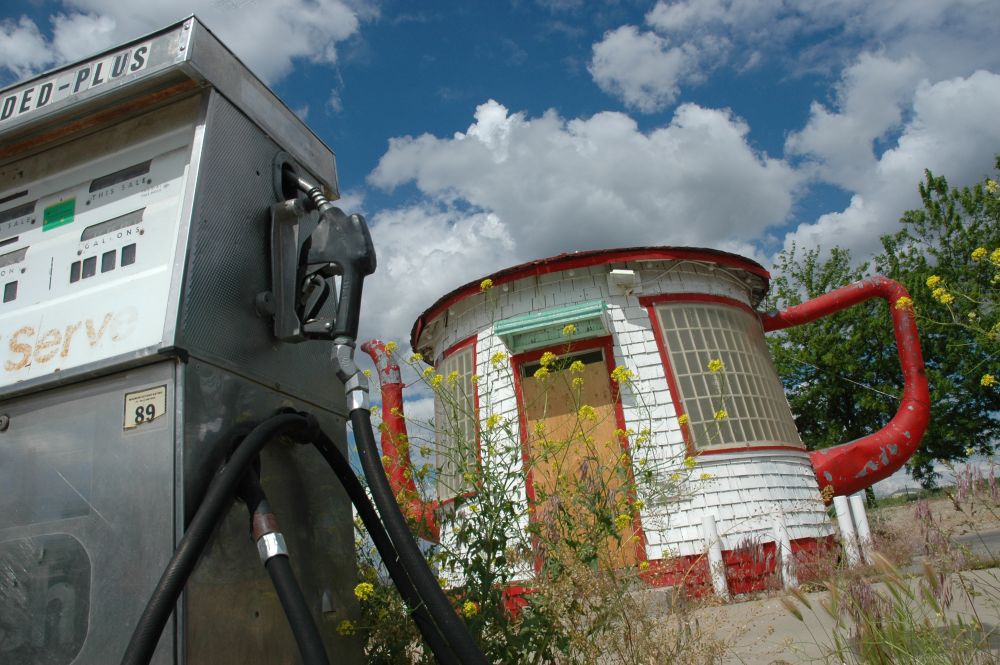
The next Hop Queries dispatch will come to you from our house in Seattle, Washington, 170 miles from the Teapot Dome Historical site in Zillah (photo above was taken during a 2008 trip). I mention that location because there’s a lot of Yakima Valley beyond Yakima. It’s one thing to be located only 151 miles from Single Hill Brewing in Yakima itself, which has become a gathering spot for brewers in town to select hops they will brew with the next year.
It’s a bit farther to many of the farms throughout the Valley and I look forward to the drive(s). (On a day-to-day basis it probably matters more to us that it will be only a 25-minute walk to Single Hill Commons and not much farther to the Ballard Brewing District.)
Meanwhile, hops do not care that we are busy packing. Most of the news can wait, but the USDA’s annual report about how many acres were strung for harvest in the Northwest and a similar survey from Germany should not. Nor should a paper in Nature Communications about advancements in the application of contemporary genomic tools in hop research. In both cases, I must be brief.
STRUNG FOR HARVEST
(A quick note. The USDA survey includes hops grown in Idaho, Oregon and Washington. Farmers elsewhere produce less than one percent of what is grown in the country. I spent a few days this past winter hanging out with growers in Michigan and New York and am a fan of what they are doing, so I do not mean to demean their work. But it is easier to use the shorthand everybody else does and refer to the USDA numbers as “American production.”)
After reducing acreage from 60,872 acres in 2021 to 41,654 in 2025 (that’s 19,218 acres), American farmers indicate that total acreage will remain basically the same in 2026 (at 41,642; 12 fewer acres than in 2025, less than three-tenths of one percent lost). The German Hop Growers Association reports that farmers will harvest 5.8% fewer acres in 2026 after slicing 6.5% in 2025 — leaving 44,117 in 2026, compared to 50,136 in 2024.
More about the numbers inside those numbers:
– It should not be a surprise that a press release from the German hop growers about acreage states, “The mood in the hop market is currently poor” and “the oversupply of aroma hops had made production cuts necessary for several years.” The most significant acreage losses occurred in the Perle, Hallertau Tradition, and Hallertau Magnum. They account for 2,260 of the 2,719 acres grubbed in 2026.
– Sixty-two hop growers in Germany ceased production in 2025, leaving 904 hop growing farms, most relatively small. The average farm size in the American Northwest if 670 acres; in Germany the average is 50 acres.
– Idaho farmers strung 796 additional acres for a total of 5,898. Some of those are Helios, acreage of which has been riding a roller coaster, some are because of shifting contracts, and others because Anheuser-Busch Elk Mountain Farm is reporting acres that were planted in 2025 and this year will be producing a crop, including for Hallertau Mittelfrüh and Saaz.
– Oregon farmers strung 89 additional acres, much of that “other varieties” (see below), for a total of 5,443.
– Washington farmers will harvest 897 fewer acres, but that’s still 73% of Northwest acreage. Blame CTZ, down 960 acres, from 4,114 acres to 3,155.
– “Other varieties” account for 1,594 acres in Idaho, 712 in Oregon, and 3,190 in Washington. At the same time in each state the number of varieties that farmers are reporting acreage for is shrinking. That doesn’t mean they aren’t being grown, but in most cases acreage is limited. Washington farmers provided acreage for 36 varieties in 2021 and 30 in 2026, Idaho farmers 22 in 2021 and 16 in 2026, and Oregon farmers 19 in 2021 and 14 in 2026.
– Citra acreage grew 5% to 8,030. That’s far below its peak of 12,044 in 2022, but the second straight year acreage has increased. Simcoe and Mosaic both declined moderately, but not as much as newcomers Krush and Dolcita increased.
– Acreage for Krush, commercialized in 2024, increased from 331 acres to 506. That’s more than Talus, Ekuanot or Sabro, varieties commercialized in 2020, 2014 and 2018 respectively that came flying out of the gate. Growers strung 261 acres of Dolicta, the first time acres have been reported since she was commercialized last year.
– Although Thora — the first named variety from a breeding program funded by the Hop Quality Group — might not be keeping up with Krush and Dolcita (or Tangier) there are enough acres to discuss. The USDA survey found 37 in Washington, where CLS Farms has trialed the hop when she was called HQG4. Crosby Farms in Oregon, which will donate $1 for every pound of Crop Year 2026 Estate Grown Thora contracted through Aug. 31, 2026 to the Hop Quality Group USDA-ARS partnership, has 20 acres. Jackson Hops and Gooding Farms are both growing Thora in Idaho. Like other public varieties, she is available to farmers anywhere in the country for commercial production, but they wouldn’t expect a first-year crop.
– Centennial acreage surpassed Cascade, probably for the first time ever (that Idaho did not report Cascade acreage in 2025 confuses matters). Growers strung 2,632 acres of Centennial and 2,504 of Cascade. In 2017, those varieties were one-two in acreage; 7,175 of Cascade and 5,534 of Centennial.
That’s enough numbers. Reporting is underway for story about the implications of the most recent acreage decisions that will post next month at Brewing Industry Guide.
HOP QUIZ
What did farmers in the Poperinge (Belgium) region hang in their hop fields in the final days before harvest?
TOOLS TO BROADEN HOP DIVERSITY
“Extensive variation between chromosomes of North American and European hop” credits 31 contributors, which only hints at the amount of research that went into this project. The report contains words that you and I may never have used in our lives. I will be contacting some of the contributors to help me (and you) better understand what this means for hop breeding, and thus what it means for the future of hops in general.
Really quickly, here is a taste:
– “Combined with our findings, this calls for a thorough taxonomic revision of Humulus genotypes sampled in Europe and the Middle East to investigate if currently undescribed distinct Humulus lineages exist on the Eurasian continent. Utilizing the full gene pool of Humulus will open broader opportunities for breeding more climate tolerant cultivars with optimized metabolite content.”
– “By showing that interspecific breeding has primarily reshuffled whole chromosomes and by identifying specific Eu and NAm haplotypes on chr08 and chr05 that additively contribute to increased α-acid content, our study highlights how targeted selection of defined lineage segments can be used to optimize agronomic traits in hops. Further, the narrow genetic base of modern cultivars and the pronounced differentiation between two H. lupulus sub-clusters in Europe and the Middle East argue for a broader exploitation of the Humulus gene pool to breed more climate-resilient, high-yielding varieties.”
A haplotype is a group of genes within an organism that was inherited together from a single parent.
– “Through the haplotype resolution of the Apollo assembly, we have further gained deeper insights into the intricate structural and genetic architecture of the complex hop genome. This will facilitate substantial enhancements in the genetic understanding of agronomic traits.”
HOP QUIZ ANSWER
Farmers in Belgium feared gusty winds and thunderstorms that could destroy a hop yard in the final days before harvest, and they hung large straw hop devils in their fields to ward off the bad weather. The hop museum in Poperinge has an oral history from Bertin Deniere, a teacher and museum guide, in which describes the final days of harvest.
“Singing and in droves we went back to the field to witness the hop guy being ‘hanged’ from the last pole of the field and set alight with a burning torch made from a rolled-up newspaper. In a way it looked like an execution, our revenge against nature for weeks of pent-up frustration and endless toil under the burning sun. And we would dance and sing around the guy until the last embers of the bonfire had died out.”