* Celeste and . . . Teorem?
* Hop quiz
* Shellhammer honored
* Velvet Cake hop blend
Welcome to Volume 9, No. 12. Hop Queries Central is moving to Washington state. Soon. Hard to say how soon, because you may have read that recent events are keeping the disrupted housing market disrupted. Meanwhile, these dispatches may at times be brief. But I promise to get to the matter of discussing the quality brewers most in Cascade before long.
CELESTE AND . . . WHAT?
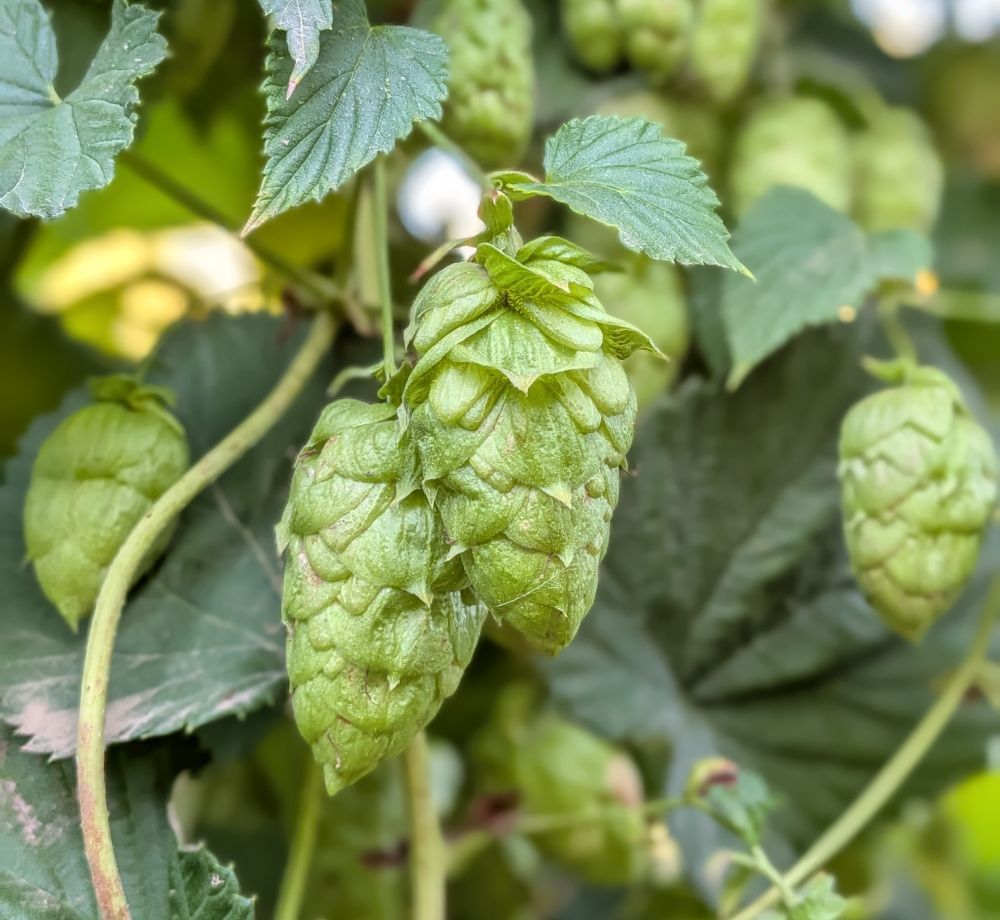
West Coast Hop Breeding announced the release of Celeste, formerly known by experimental names WCHB-102 and 2B. She is named for heavenly beauty, and features bright, sweet, and clean notes of passion fruit, honeydew, and pine.
The news is noteworthy enough to merit a post of its own. If you didn’t read it and don’t want to click over, here are the basics. Celeste (10-12.8 alpha acids, 6-7% beta acids, 1.5-2.3 mL/100 grams total oil) is the second hop from WCHB, established by five Oregon hop farming families in 2016 to ensure that Oregon hop growers have a sustainable future by developing excellent aroma varieties. She is available through The Hop Guild, Charles Faram Canada and US, and direct from West Coast Hop Breeding.
Chris Holden at The Hop Guild describes Celeste as a small but mighty bulldog. She “has the potency to brew fun beers and sit at the big boy table with the big sexy hops,” he said. “My favorite is the lime and passion fruit combo that hits you in the face and carries through to the finished product.”
You can expect to find Celeste and other newcomers like Luna and Rhapzody on the International Hop Growers Convention list of 342 varieties “grown on Earth with an economic purpose” next year, unlike a hop like Monohon, which will not be widely grown. Looking over the 2025 list, I was surprised to see newcomer Teorem from France. She is grown pretty much exclusively for Brasserie Meteor (yes, you are seeing the same letters in both), France’s oldest brewery. However, Hop France must string a few extra plants to ensure against a shortfall, and a small sample recently made it to the Colorado. She is the most American-like variety to emerge from the Comptoir Agricole private breeding program and showed up in a beer from Milieu Fermentation Aurora. Will that be the only sighting?
HOP QUIZ
What hop variety shares her name with a hop disease?
BREWERS ASSOCIATION HONORS SHELLHAMMER
The Brewers Association announced that Tom Shellhammer, Nor’Wester Professor of Fermentation Science at Oregon State University, has been chosen to receive its 2026 Recognition Award. He is being honored this week at the Craft Brewers Conference in Philadelphia.
A press release states he is being recognized for his contributions to brewing science, education, and industry collaboration. Straight out quoting begins now:
“For more than two decade Shellhammer’s research has advanced the
understanding of hop chemistry, beer flavor and, quality. His work integrates analytical chemistry and sensory science to address practical challenges faced by brewers and hop growers, improving consistency and product quality.
“Through his teaching at Oregon State University and numerous industry courses and workshops, Shellhammer has trained and mentored generations of brewers. He is widely known for translating complex scientific concepts into practical knowledge for industry application.
“His collaborations with breweries, hop growers, and suppliers have strengthened the connection between research and brewing practice, helping elevate quality standards across the global brewing community.”
The Celebrating Oregon Beer Newsletter has plenty more details about Shellhammer’s career. It includes this: “In some ways, however, his sterling resume understates his contribution to the field of American brewing. His research has gone hand-in-glove with craft beer’s transformation over the past 15 years [Hop Queries would make that 20] and work at his lab has been instrumental in informing brewers who have created a whole new idiom in beer focused on the intense flavors and aromas of American hops.”
Twenty years because beginning in 2006, after being approached by Jaime Jurado, president of the Masters Brewers Association of the Americas, Shellhammer worked with many others to organize the First International Brewers Symposium on Hop Flavor and Aroma in Beer, held in 2007 at Oregon State University. That was followed by a second symposium in 2017, and a third is planned for 2027. The agendas reflect how dynamic hop science can be.
2007 Agenda
– Beer lightstruck flavor: The full story
– The impact of humulene expoxides on beer flavor
– The occurrence and nature of kettle hop aroma
– Changes in hop derived compounds during beer production and aging
– Investigations of hop-derived odor-active components in beer
– Character-impact hop aroma compounds in ale
– Flavor and aroma characteristics of pure hop aroma and different beer styles
– Ancestry and genetic variation in hop development
– Polyphenolic compounds in beer
– Influence of hop polyphenols on beer flavor
– Electron paramagnetic resonance comparison of the antioxidative activity of various hop components in beer and fruit juices
– The international bitterness unit, its creation and what it measures
– Hop components and their impact on the bitterness quality of beer
2017 Agenda
– Free and bound polyfunctional thiols and terpenols in dual-purpose hop varieties
– Cultivation conditions of Saaz hops for creating attractive hop-derived aroma in beer
– Reconstitution of pilsner beer aroma by recombining 76 aroma compounds
– Genomics-guided breeding in the wild genetic landscape of hops
– Influence of new German aroma hop varieties on flavor description
– Hop and hoppy aroma: Comprehensive characterization of hop essential oils and hoppy aroma of beer
– Instrumental analysis of hop aroma in beer – On the challenges of transforming a research application into a QC tool
– How to monitor odorant thiols during wine and beer elaboration?
– History of Hop Aroma Research
– Controlling dry-hop flavor in beer
– 4-Mercapto-4-menthyl-2-pentanone in hops: Impact of Variety & Provenance
– Behavior of hop-derived flavor compounds during beer production and their contribution to the varietal aroma of ‘flavor hop’
I’m already looking forward to the 2027 agenda.
BLENDING FOR DIVERSITY
Roy Farms has produced a hop blend in partnership with the National Black Brewers Association, with a portion of the sales benefiting the NB2A. Velvet Cake hop blend was released this week at the Craft Brewers Conference.
Members of the NB2A selected the hops for the blend during 2025 harvest. They chose a mixture that includes 40 percent Cashmere, 30 percent Azacca, 15 percent Chinook, and 15 percent Amarillo. The aroma is described as sweet candy-like, citrus and tropical with hints of resin and spice.
“This partnership is a vital example of leadership working together in the food and beverage sector to build and foster community,” said Jon Renthrope, NB2A president. “The Velvet Cake hop blend is a very phenomenal product that embodies the best attributes of collaboration, fellowship, and STEM research. We are enthusiastic about the opportunities this milestone occasion will bring forth.”
HOP QUIZ ANSWER
The answer is Mosaic. The name was chosen to represent a mosaic of aromas and flavors.
Hop mosaic virus was first described by E.S. Salmon (you’ve read that name here a few times) of Wye College in 1923. It lethal to Golding-type hop cultivars (e.g. Bramling. Eastwell Golding, Wye Mathon), many of which are no longer grown.