WCHB looks to the heavens for newest hop name

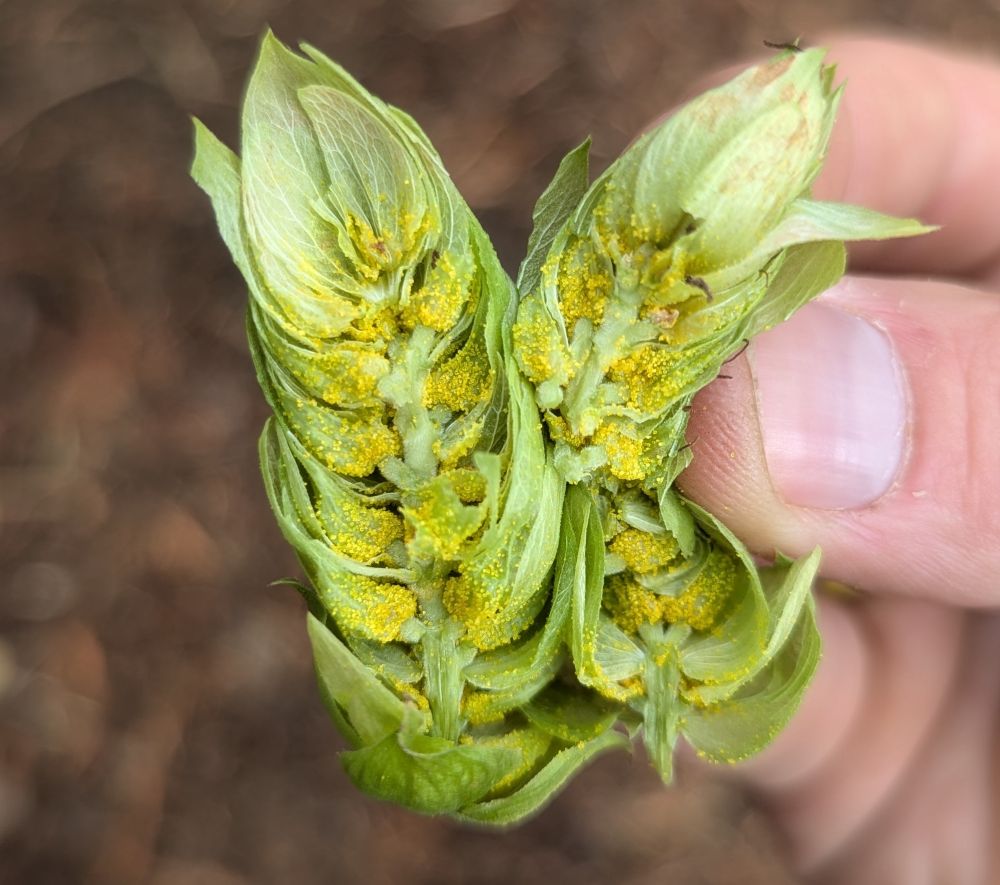
A closeup look at the lupulin and Celeste, a hop developed by the West Coast Hop Breeding

West Coast Hop Breeding today announced the release of Celeste, formerly known by experimental names WCHB-102 and 2B. She is named for heavenly beauty, and features bright, sweet, and clean notes of passion fruit, honeydew, and pine.

Celeste (10-12.8 alpha acids, 6-7% beta acids, 1.5-2.3 mL/100 grams total oil) is the second hop from WCHB, established by five Oregon hop farming families in 2016 to ensure that Oregon hop growers have a sustainable future by developing excellent aroma varieties. Pat Leavy, one of the farmers in the collective, does the breeding, making crosses from germplasm he has collected during the past 20 years. Celeste has “heavy downy resistance plus powdery tolerance for production in organic systems.” The hops Leavy grows are certified organic.

Ben Smith at WCHB member B&D Farms adds, “Celeste yields well with a minimum of inputs.”

Celeste is available now through The Hop Guild, Charles Faram Canada and US, and direct from West Coast Hop Breeding.

At this moment, The Hop Guild has enough 2025 crop for full batch brewing. Chris Holden, director of sales and marketing, made it clear he his a fan while talking to brewers at the New York State Brewers Conference. He first smelled what was then called WCHB-102 sitting in bales at the mill while THB was producing Citra Hopsauce, its proprietary flowable extract. “The bales overpowered the Citra Hopsauce,” he said. “That told me that the she was a winner.”

He describes Celeste as a small but mighty bulldog. She “has the potency to brew fun beers and sit at the big boy table with the big sexy hops,” he said. “My favorite is the lime and passion fruit combo that hits you in the face and carries through to the finished product.”

Luna introduces flavour with a ‘u’

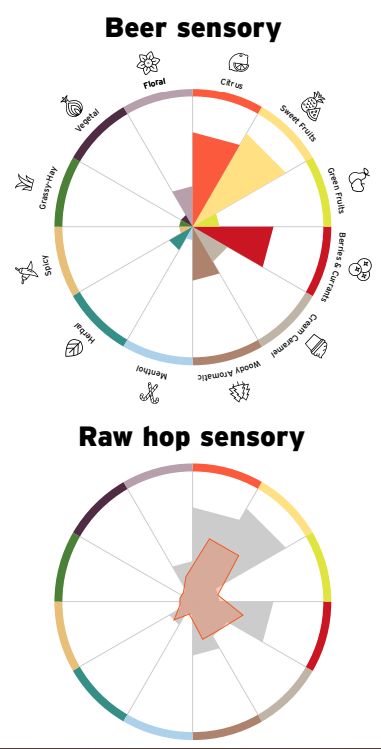
Luna hop sensoryIn a press release announcing that the experimental hop previously known at HPA-033 will be called Luna, Hop Products Australia states, “Just like our customers, our hops are big characters. When choosing a name, we like to consider both the hop’s flavour profile and its position in our portfolio. Luna seemed like the obvious choice for a hop that is distinguished by lush mango, dark berry and spicy citrus characters, alongside a high polyphenol content that elevates the flavour profile and mouthfeel.”

One more sentence from the press release to give you an idea which other varieties Luna is like to hang out with: “With an aroma intensity akin to Krush, and a biotransformation potential similar to Galaxy, Luna is a joy to experience in the whirlpool and dry hop.”

HPA suggests that a late whirlpool addition of 1-2g/L (0.4-0.7lb/bbl) accentuates spicy citrus characteristics, which can present as marmalade when interacting with darker malts. A dry hop of 4-10g/L (1.3-3.3lb/bbl) elevates the lush mango and dark berry character.

Luna is the result of a 2003 cross between a high alpha Australian male and Liberty, herself a cross made in Oregon between Hallertau Mittelfrüh and a German male. She contains 13.2-15% alpha acids, 7.5-8.2% beta acids, 1.9-2.5 mL/100 grams total oil.

Read more

Rhapzody newest hop variety on the block

Clayton Hops in New Zealand has given the name Rhapzody to the experimental hop variety formerly known as CIP 014, bred in partnership with the New Zealand Institute for Bioeconomy Science (formerly Plant and Food Research).

Here are the basics: 13-14% alpha acids, 4.5-6% beta acids, .8-1.3 mL/100 grams total oil. Rich in 3s4mp precursors, which may add passionfruit, grapefruit and sometimes rhubarb aromas and flavors. Her ancestry includes Nugget, Smoothcone, Southern Cross, and Pacific Sunrise.

Clayton promotes her “intense tropical, passionfruit and pineapple character. Can be used both on the hot side and as dry hop in a variety of styles targeting a fruit forward hop profile.” They provide this sensory diagram:

Sensory for Rhapzody, a new hop variety from Clayton Hops in New Zealand

They suggest Rhapzody pairs well with Mosaic, Citra, Cascade, Eclipse, Nelson Sauvin, and Motueka; and that she could be used in place of Galaxy, Strata, El Dorado, or Simcoe.

HBC 1019 = Dolcita = Peach, tropical daiquiri

Here is the first paragraph from the Hop Breeding Company press release:

“Hop Breeding Company (HBC) is proud to announce the official commercial release of Dolcita brand HBC 1019, a new and innovative hop variety designed to meet the high expectations of brewers and beer lovers around the world.
Created in 2016 using traditional breeding methods and HBC’s proprietary breeding stock, Dolcita is one of the fastest hops ever brought to market by HBC.”

Until today it was called HBC 1019. Nine years from cross to name is really fast. Jeff Alworth has written about the semi-early years.

If I find a link to the full press release I will link to it. (Here is the post at the Haas website.) I’ve written about Dolcita for Brewing Industry Guide in a story that will post soon. (Behind a paywall, but no apologies. A subscription is worth the price.)

Meanwhile, more from the press release: “Dolcita is the boldest representation of the Hop Breeding Company’s mission: to provide brewers with the best, most unique, and most sustainable hops on the planet,” said Jeff Dailey, sensory manager at John I. Haas. “With aromas of caramelized pineapple, peach rings, and orange juice, consumers will think they’re drinking a tropical daiquiri rather than an IPA. Beers made with Dolcita definitely stand out due to their strong, distinct flavor profile.”

(The Hop Breeding Company is a partnership between Haas and Yakima Chief Ranches.)

And here’s an outtake (meaning it was in my story and then it wasn’t) from Tiffany Pitra, Yakima Chief Hops senior manager, hop research. “My team consistently gets peach candy aromas in hop assessments and beer tasting. We trialed three yeast strains with 1019 and consistently described the beers as having pineapple, peach, and sweet aromatic notes,” she said. Participants in a YCH/YCR program in which brewers trial products also provided feedback. “I’ve chatted casually with some brewers and ‘tiki drinks’ (think painkiller) seems to a common descriptor.”

A new hop for Halloween

Hopsteiner gives HS16660 a name: Erebus

It seems appropriate that Hopsteiner chose Halloween to announce that a cultivar previous known as HS16660 will be called Erebus, the primordial deity of darkness in Greek mythology. A press release states, she “embodies the essence of its chaotic origins, serving as a bold disruptor to the world of hops.”

Brewers may instead focus on the blueberry, citrus, candied fruit and floral/rose character the hop provides. She contains 8-11% alpha acids, 3-4% beta acids and 2.3-2.8 ml/100g essential oil (including an usually high amount of geraniol).

Erebus is Hopsteiner’s third release — along with Helios and Alora — in three years. All three benefit from research identifying genetic markers. The company’s breeders used those markers to select multiple disease resistant traits, resulting in stacked resistance. Because the plants have multiple layers of protection from mildews, the amount of chemical fungicide applications required to protect them is reduced.