* What Strata tells us
* Hop quiz
* The Terra family
* Random observation
* Mac Hops turns to brewing
Welcome to Volume 10, No. 4. Hop harvest has begun in the Northwest. Fresh hop ales are already being poured. How could that be? I wrote about why there are questions about when “wet hop” season should begin and why those beers can still taste really good in October for Brewing Industry Guide.
STORAGE STABILITY AND VINTAGE DEPENDENCE
Last month I recommended listening to one of two podcasts with Tom Shellhamm and Cecile Chenot at Oregon State University. They featured information from two studies. One examined the aging of Citra, Cascade, and Centennial under commercial storage and the discrepancies between sensory quality and HSI classification. The other evaluated Strata across multiple harvest years, farms, and fields, focusing on terpene and polyfunctional thiol profiles. I already summarized the key takeaways from the first for Brewing Industry Guide in March. Here are the highlights from the Strata study:
– Strata is particularly rich in 3S4MP, with levels up there with Mosaic, Nelson Sauvin, Thora and Hallertau Blanc.
– However, concentrations varied by about five-to-seven-fold between certain harvest years and field combinations. It does not work to simply plug 150 parts per trillion into a formula to calculate the possible level of 3S4MP your Strata addition is contributing to a beer.
– From a chemical standpoint Strata displayed notable stability from year to year when stored properly (cold and in low-oxygen packaging).
– Oxygen is a bitter enemy of hop aroma. As expected, the most pronounced losses were observed in the monoterpene fraction when high-oxygen samples were compared to low-oxygen one, while sesquiterpene hydrocarbons remained comparatively stable. Among free thiols, 4SMP was the most sensitive, with concentrations deceasing by about 50 percent, while 3SH and 3S4MP lost 15 to 20 percent.
HOP QUIZ
What is the year exed out in this statement refer to? Taken from the annual BarthHaas Hop Report.
Starting with the harvest of [xxxx] the shift a buyer’s market could no longer be overlooked. Hop production again exceeded consumption. Further factors contributed to the situation:
– General lack of interest in buying because of stagnation of beer production and unsure future development.
– Further reduction of hop stocks in breweries due to high levels of interest rates.
– Declining hopping ratio.
I will give you some choices: 1981, 1991, 2001, 2011.
STAKING OUT ALPHA TERRITORY
The Hop Breeding Company has commercialized one experimental cultivar and given a new name to an established variety to create a family it calls Terra Alpha.
By the numbers. The hop known as HBC 682 was first called Pahto when she was commercialized in 2018, then HBC 682 again a few years ago, will now be known as TerraFlux. The experimental known as HBC 1325 is being called TerraSurge.
“HBC is well known for our intense flavor-forward hops (Citra, Mosaic, Krush, Dolcita, etc.), but innovation in alpha has also been an important part of our breeding program,” says Jennifer Burns, Executive Director of Hop Breeding Company. “TerraFlux has already proven itself at commercial scale, and TerraSurge represents the next generation of that work. With our Terra Alpha series, we’re giving that part of our portfolio an identity of its own.”
“TerraSurge encompasses every innovation we’ve developed over the last seven years. It’s a breakthrough,” says Michael Ferguson, director of hop breeding at John I. Haas. “That’s what we want a hop to look like.”
HBC is a partnership between Haas and Yakima Chief Ranches.
RANDOM OBSERVATION
Monday at Appellation Beer I linked to a lengthy story on Lagunitas Brewing. In it “brew monster” Jeremy Marshall is quoted as agreeing that because of advancements in hop growing, “Brewers don’t have to have much skill anymore, whereas before, your mistakes were very, very evident.”
After he added that in decades past hops were lower-intensity and were more difficult to use for more bold brews, he said “The breeders are making these hops that are so loud, you can just use one of those and instantly have a hit.”
In addition, the story says brewing technology has advanced to such a degree that Marshall said he is amazed at how many parts of the process arrive ready for hookup, where once they were patched together in do-it-yourself homebrewing operations. With today’s advancements, “You essentially have a Keurig for making great beer,” he said.
Let’s simply skip that last thought. Keurig and Anheuser-Busch actually tried that, and others have since. Medal winning beers did not follow.
Marshall is neither neanderthal nor neophyte. During a panel discussion at the 2010 Craft Brewers Conference when the conversation turned to character of beers brewed with pellets he suggested that T90s sometimes exhibit “a characteristic veggie bit people talk about, although they can’t say what they mean. We know what they mean by that. We’ve tasted the difference.”
By then Lagunitas was using CO2 extract in a wide range of its beer; at a time when many smaller brewers considered extract something industrial breweries used to lower costs. “We use hop extract because it increases the quality of our beer,” Marshall said.
I suspect there is a more nuanced conversation to be had with Marshall about what “less skill” means. I’d like to have it . . . someday.
For now, this observation. When new varieties or new hop and hop-related concentrated products are introduced the best brewers will use them to translate what they can imagine into something new and delicious. Some brewers will get excited, treat them as toys and overuse them, release beers that are one dimensional, and—we hope—do better next time. Some brewers will make mediocre beers and some lousy beers. They might be one-hit wonders, but they’ll still be lousy beers.
HOP QUIZ ANSWER
1981.
Coincidentally, Cluster still occupied 55 percent of acres harvested in the United States that year. What was second? Bullion. That’s probably a quiz question I could have saved for another issue.
PRETTY SURE WHOSE HOPS THIS BREWERY WILL USE
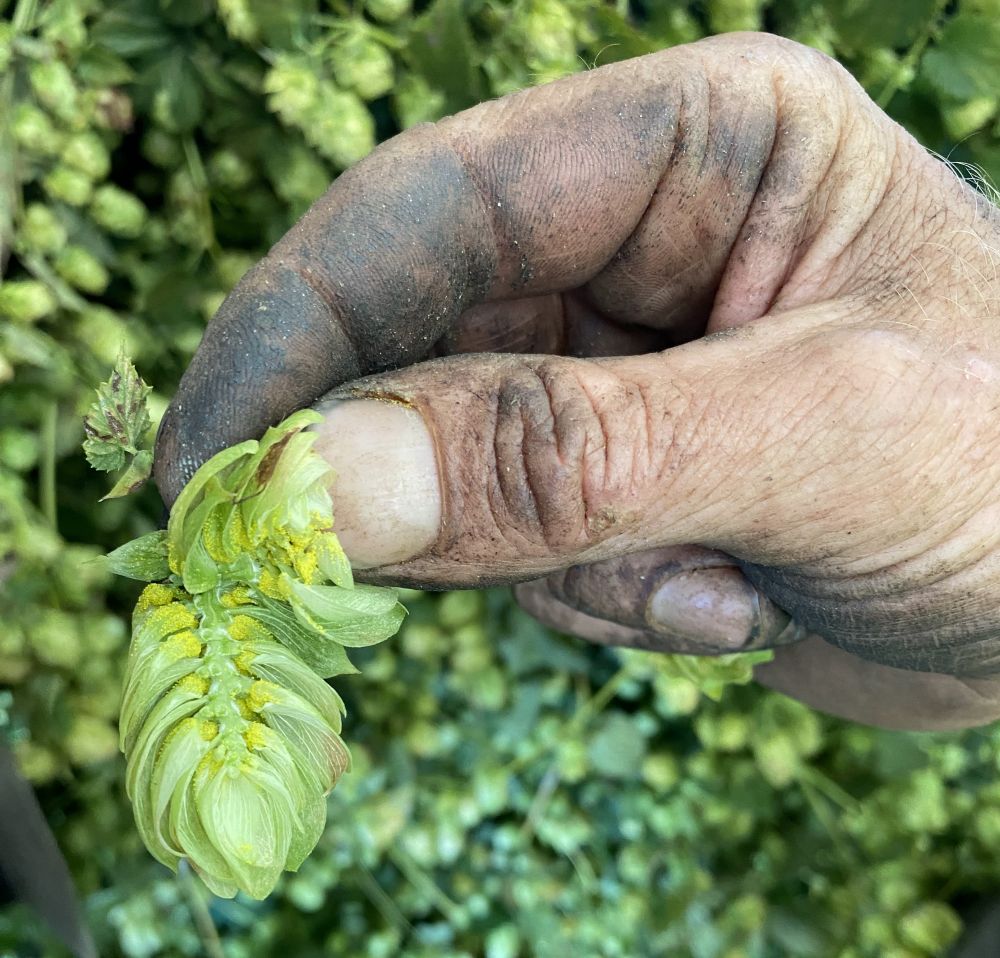
That’s Brent McGlashan’s hand* holding a hop at the top of this newsletter. His face is more familiar to many American brewers. He’s a regular at the Firestone Walker Invitational and has visited plenty of breweries as well as the Craft Brewers Conference.
He’s the face of Mac Hops, a fifth-generation family hop farm in New Zealand and the guy who during harvest sleeps in a small room next to the hop kiln.
Now he’s a brewery owner. “Ultimately, we would have loved to have the brewery on the farm,” he told Pursuit of Hoppiness. However, the opportunity came up to acquire two brewing kits and the former home of Hop Federation Brewery, which is not far from the farm.
“We’ve been wanting to do some brewing for a number of years — it’s always been a slow burn in the back of our minds and one of the reasons was to have a diversified farm income,” McGlashan said. “Hopefully it (Cultivation Brewing) will be an income and not a loss, eventually.”
Can a Cultivation-Bale Breaker collaboration be far off?
* The photo was taken when Daria and I visited New Zealand in 2023.