* Hop quiz
* Cascade Cup
* Cascade Agenda
* Hop quiz answer
Welcome to Volume 9, No. 10. Wonder what happened at the 2026 American Hop Convention? I filed a report for Brewing Industry Guide. One takeaway is that although acreage may or may not shrink again in 2026, hop growers are focused on ensuring a healthy future. Elsewhere, Clayton Hops in New Zealand announced that experimental hop CIP 014 now has a proper name: Rhapzody. Beyond that, as the subject line states, this is an all-Cascade edition. Regular transmissions will resume in March.
HOP QUIZ
Which one of these hops is not an offspring of Cascade?
a) Crystal
b) Taiheke
c) Mandarina Bavaria
d) Mistral
CASCADE CUP WINNERS
Ethan Smith of Smith Valley Farms in Oregon won the 2025 Cascade Cup, B&D Farms in Oregon was second, and Perrault Farms in the Yakima Valley was third. Should you have forgotten, the Hop Quality Group created the competition in 2013, and its members judge the entries.
B&D Farms has won the cup three times, and (now) finished second twice. On Aug. 8, Ben Smith, the B in B&D, posted an Instagram photo with a comment that, “This is the probably the best Cascade field I’ve ever seen, and it will be my entry into the Cascade Cup.” It wasn’t. Smith changed his choice of what to enter after brewers made post-harvest selections. “The brewers know more than I do,” he said.
The competition wrapped up a great month for one of Smith’s sons, Ethan. He rents land for Smith Valley Farms from a neighbor and from B&D, he grows Crystal for Sierra Nevada Brewing, and Citra and Cascade for John I. Haas. Before the convention, he received a gold award from Haas for the quality of his Citra.
CASCADE AGENDA
I’m not gonna lie. It makes me smile to share these texts from Robert Young III, Mr. Everything at Tapped 33 Craft Brewhouse in Augusta, Georgia. He was briefly in Colorado and at the time drinking a draft beer called Cascade Agenda at Bierstadt Lagerhaus. It wasn’t actually a collaboration with Bierstadt, but we will get to that.
Your collab with Bierstadt is amazing! What was the pound per barrel on the Cascade?
Although I was about 30,000 feet in the air, returning from Michigan’s Great Beer State Conference, I was able to send him the details (don’t worry, they are coming). I also commented I was surprised that Amalgam Brewing agreed to release a beer hopped only with Cascade. They’ve got a business to run, and Cascade isn’t exactly a hop of the moment. Some might call it boring.
Thank you! It’s a fantastic beer. Bright and lemony citrus with beautiful light pine note. Of course, the pils background is top notch. That barke malt really shines on it as well. It’s not boring at all! It’s simple and complex at the same time because it is hop forward for sure but drinks light enough as a lager. With a crisp dryness that makes me want to take another sip.
Before getting to the story behind this West Coast Pilsner and the promised details, know that Young is a Navy veteran and Michael James Jackson Foundation for Brewing & Distilling scholarship recipient who completed Siebel/Doemens WBA Master Brewer Program in 2024. For now, he brews Tapped 33 beers at Savannah River Brewing. He poured them at the last two Great American Beer Festivals. His plan to open a brick-and-mortar brewery in Augusta seems to be developing nicely.
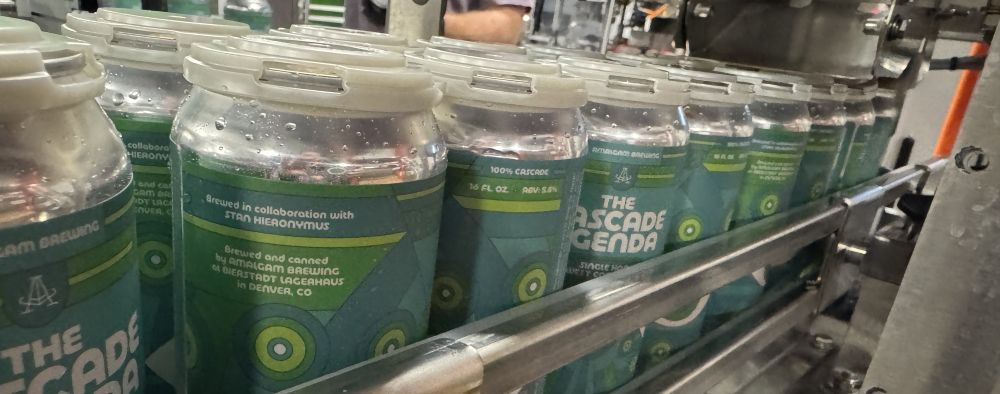
So how did this happen? It began with an email from Phil Joyce, co-owner and head brewer at Amalgam, asking if I’d “have any interest in designing a beer together.” On the one hand, a silly question. Of course, an invitation to create a beer that picks and chooses from new varieties or advanced products, that focuses on process and farms, that taps into what scientists are still discovering, and considers whatever else I write about here is flattering.
Joyce and Eric Schmidt founded Amalgam in 2017 as a small-batch blendery focused on mixed-culture and barrel-aged beers that earned a loyal following. They won a gold medal at the World Beer Cup in 2022, and Joe Stange and Kate Bernot have both put Amalgam creations on their “best of” lists for Craft Beer & Brewing. They first started making hop-forward beers in collaboration with other breweries, then Amalgam-branded clean hoppy beers when they added their own fermentation vessel at Bierstadt, where Joyce is a brewer. The first hoppy release was a WC Pils, Welcome to the Here and Now, in 2023.
Obviously, I accepted their offer. But not before considering if I was stepping over the line that separates a journalist and something else (I started to type influencer, but it should be clear I am not that). I was already from a different era when I wrote this more than 10 years ago. In addition, I appreciate that I am privileged to do what I do, and that maybe you don’t care about it. I’m writing about this beer anyway, because I really want to tell you about the hops involved and this flotation tank.
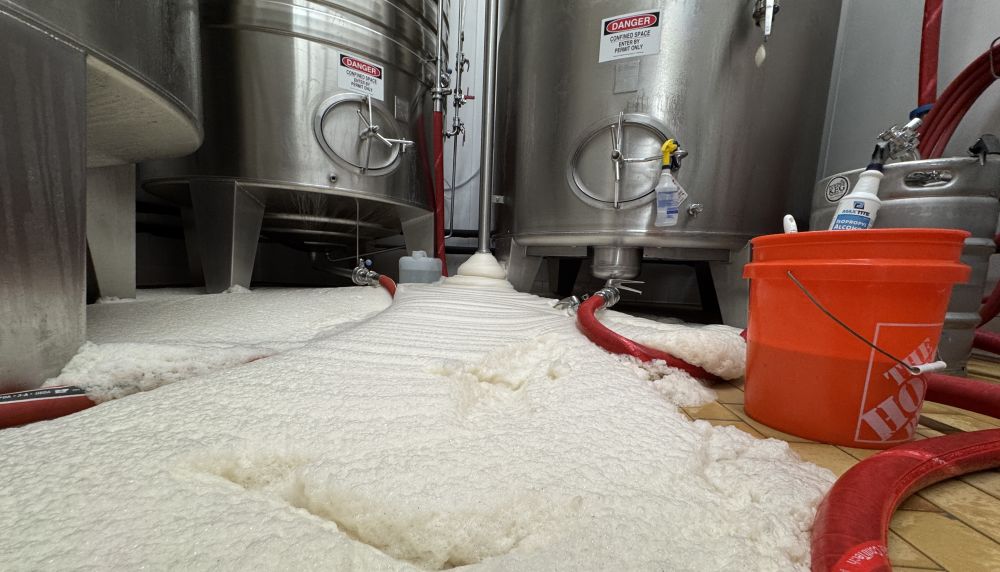
Why a beer hopped only with Cascade, rather than, say one with Dolcita, Thora, Riwaka and six other hops of the moment; added in the form of Incognito, HyperBoost, Amplifire, and Quantum; perhaps supercharged by thiolized yeast; and dosed at the end by LLZ, or selections from the Skyfarm or Euphorics collections? TL;DR. Instead, here are the basics, then more about each lot of hops.
OG: 13.2°P FG: 2.5°P
IBU: 40
Malt: 96% Barke Pils, 4% Chit Malt1
Mash Rests: 55°C for 10 minutes, 62°C for 20 minutes, 71C° for 20 minutes, decoct to 76°C for 10 minutes.
Yeast: 3470 (Bierstadt house yeast)
Fermentation schedule: Knockout at 3°C (into float tank
Hops:
5kg CLS (Lot CAS2023-CLS-1) Cascade @ FWH – 15 IBU
2.5kg CLS @70 minutes – 8 IBU
2.5kg CLS @15 minutes – 6 IBU
5kg CLS @WP – 11 IBU
Dry Hops:
20kg Crosby Deep Cut (Lot 2970)
5kg YCH Cascade Cryo (PC1-IUCAS1088)
5kg Crosby Deep Cut CGX (Lot 3202)
5kg NZ Cascade (Freestyle NL25-9PRT-CAS)
The batch size was 30 hectoliters in the kettle. Amalgam packaged 22 barrels of Cascade Agenda.
1 Most hops are foam positive, that is they improve foam, but research at Hopsteiner determined dry hopping with Cascade pellets results in a near-linear decline in foam stability. Chit malt helps build foam.
2 You won’t spot many flotation tanks outside of Bavaria, and a dwindling number within. Bierstadt co-founder Ashleigh Carter says they found “maybe 10 paragraphs across a number of books that mention them” before she and Bill Eye saw one in place at Private Landbrauerei Schönram. The tank allows for better cold break separation and primarily the separation (via flotation) of lipids, unwanted polyphenols, and dead yeast. Lipids are foam negative. Proof:
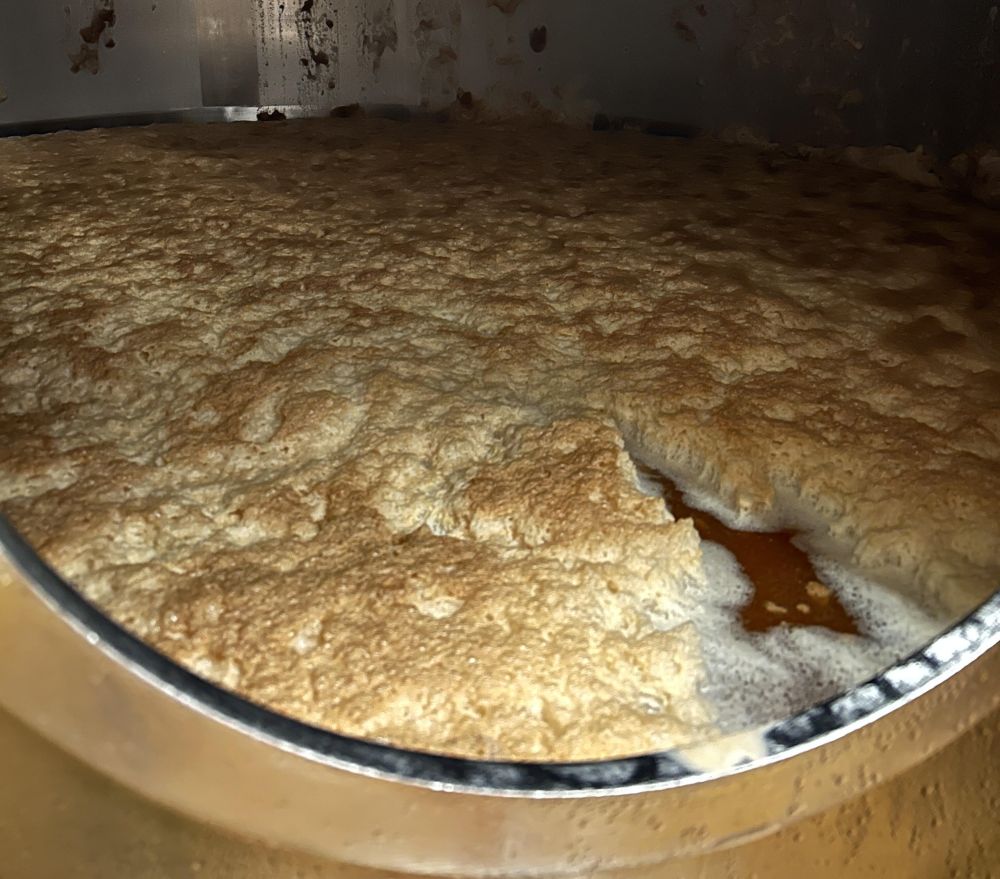
Every Bierstadt beer goes through the flotation tank and rests for two hours before being moved to a fermentor. Joyce does not use the tank for most IPAs, because the knockout temperature for ale yeast is too warm for it to create effective flotation separation. He uses the float tank for any Amalgam beer fermented with lager yeast, knocking out very cold (2-3°C).
3 Tetra is sometimes added to fine tune bitterness, but more important, it enhances foam, lacing, and cling. I didn’t include a photo of a half-full glass of Cascade Agenda decorated with rings of tight, white bubbles because I had to draw a line somewhere. Use your imagination.
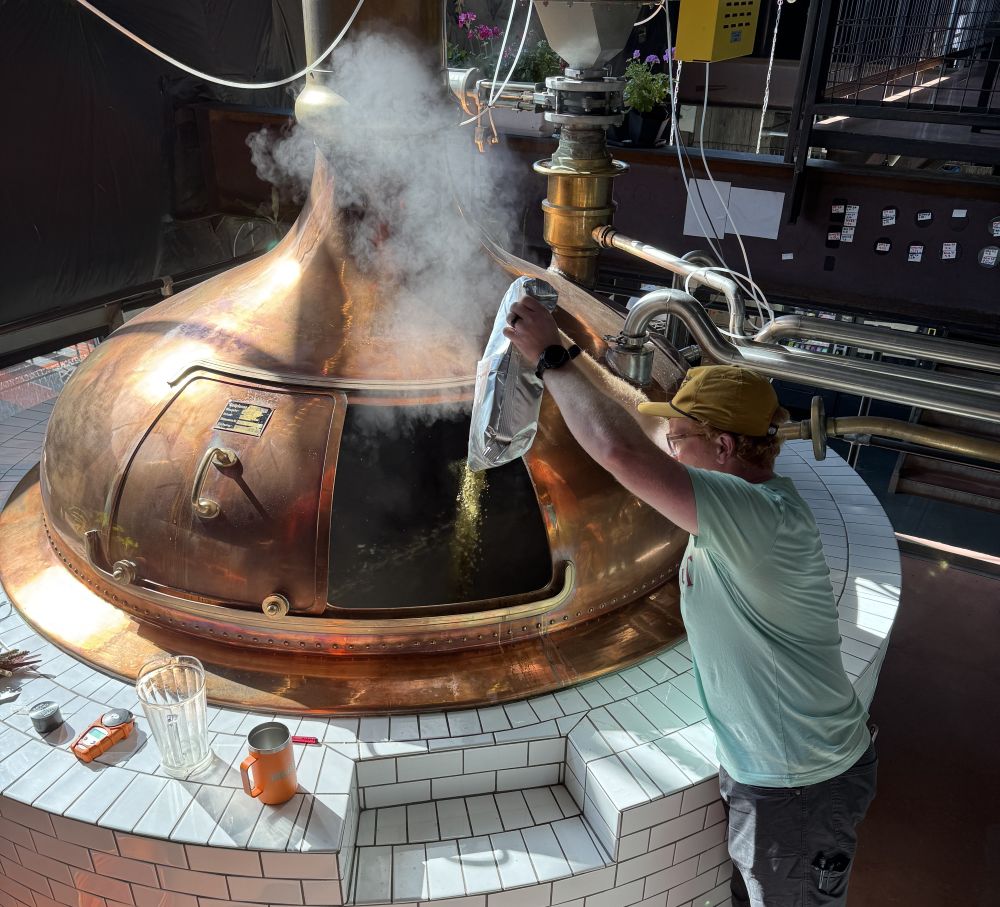
CLS Farms Lot CAS2023-CLS-1 was perfect for the hot side additions because it has a relatively low amount of alpha acids (5.8% alpha acids, 8.1% beta acids, 1.7 ml/100 grams total oil) for Cascade, allowing for the addition of more hop matter during the boil. That’s Phil Joyce making the last boil addition. (I did the honors for the whirlpool, which other than making case boxes during packaging was the extent of my labor.)
The lot was harvested Oct. 5, 2023, weeks later than most Cascade in the Northern Hemisphere. “Our late Cascade journey really started back in 2012 with Sierra Nevada and raw materials manager Tom Nielsen,” said CLS co-owner Eric Desmarais. “We realized early on the aromas they were looking for were much more intense than what we were used to in traditionally harvested Cascade.” Instead of picking Cascade for Sierra Nevada in late August or early September, which was typical, they began delivering hops harvested mid-September.
He learned another lesson after they planted virus-free Cascade in 2016. The first mature crop, in 2017, yielded 2,800 pounds per acre (the average yield in Washington that year was 2,124). CLS had enough hops to fill its contract after harvesting only 75 percent of the field. “The market was flooded with Cascade that year, and a fair amount of people just left some un-contracted Cascade fields un-harvested,” he said.
“We let ours hang while we went and harvested other varieties. At CLS, we are not ‘we’re not gonna harvest them’ kind of people, and we went ahead and picked them for spot sales,” he said. They sent samples to Sierra Nevada, and Nielsen was impressed. “We have learned more about virus free plantings since then. Now, as a course of action, we always are picking at least 25 percent of our Cascade way, way out there,” he said.
In 2023, CLS had a relatively large Cascade contract with John I. Haas. They waited until early October to harvest a small portion of the contracted amount. “The hops were pretty colorful, so I was nervous about that,” Desmarais said. He didn’t breathe a sigh of relief until Haas sensory manager Jeff Dailey sent a text that the lot was the highest rated Cascade his team received during harvest.
It was one of the most potent lots that Haas received, Dailey said. “It best conformed to what generally would be described as Cascade, with floral elements, sharp citrus elements, more than grapefruit, maybe a little bit of tangerine. Some clear, like resin sort of pine rather than dull wood.” Dailey has more to say about Cascade, which we will get to next month.
I will let the COAs from Yakima Chief Hops and Freestyle Hops do most of the talking for the additions from TV Hops in Idaho and Nelson Lakes in New Zealand. I wanted to share them because they contain more information than is typical, and perhaps represent what brewers can expect in the future. Click on either for a larger version.
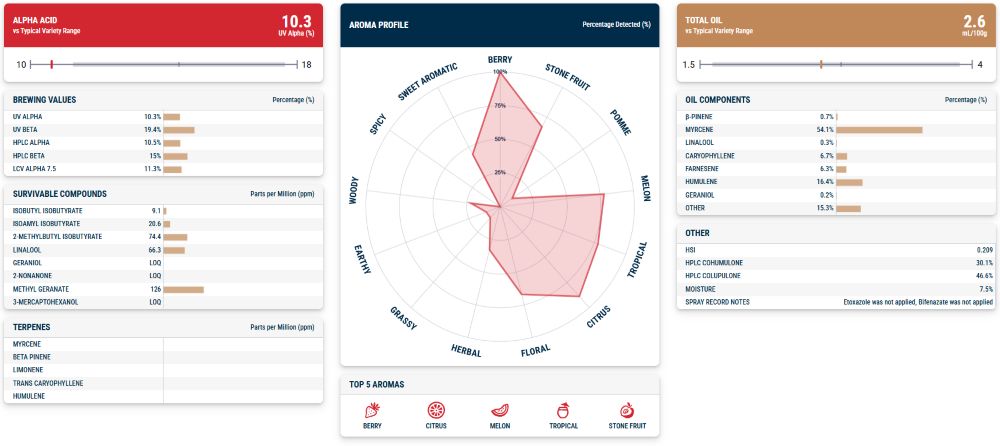
Note this Cascade is in Cryo form, that is concentrated, so naturally the numbers are higher. It contains values for YCH “survivables.”
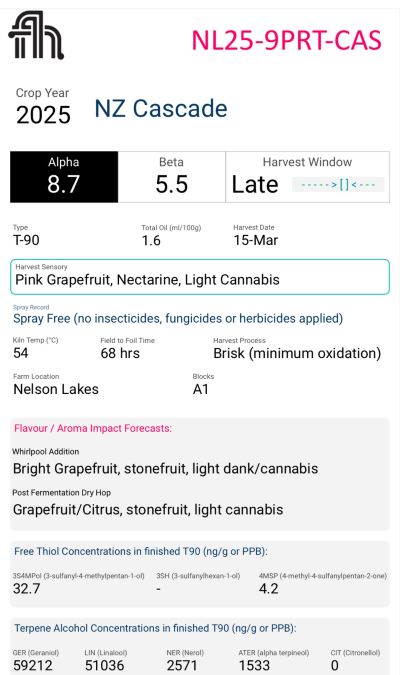
The Freestyle COA includes when the lot was picked within the harvest window, kilning and processing information, and details about thiols (put an explanation point after the last). Freestyle managing director David Dunbar had more information on this particular lot because the University of Auckland did additional testing (more thiols, but also esters). It would be great if that becomes standard.
“Cascade is always fascinating with how much its character can vary depending on the terroir, harvesting and processing,” he wrote. “(That lot) had some intense sweet fruit and tropical notes in the field at harvest, but I’d expect the citrus characters to be equally prominent in a finished beer.”
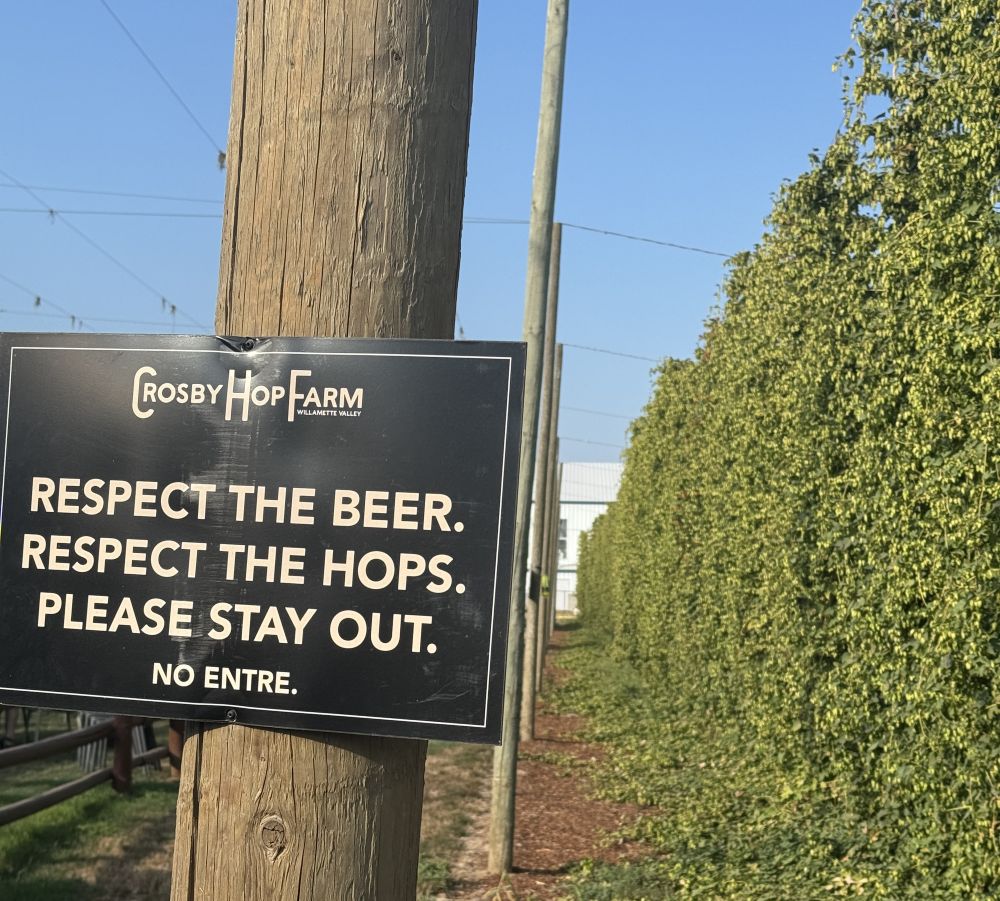
The cones in the Deep Crosby Deep Cut CGX (Lot 3202) from 2025 could be in this photo (but probably are not). TopWire | Hop Project is a beer garden on the Crosby Hop Farm with hop bines as “walls.” Initially, they let a few rows hang beyond the traditional harvest date to enhance the atmosphere. Then they discovered the aromas did not deteriorate and instead became more enticing.
I took the picture Sept. 5. The day before, Sierra Nevada had picked up Cascade from B&D Farms for Celebration Ale. These hops would not be harvested until more than two weeks later.
Crosby began calling their late picked Cascade “deep cut” in 2024, and that vintage (Lot 2970) was the largest dry hop addition in Cascade Agenda. As you probably figured out from the name, Lot 3202 from 2025 is a concentrated version of “deep cut.”
To recap, Cascade Agenda was hopped with a 2023 lot from the Yakima Valley, a 2023 lot from Idaho, a 2025 lot from New Zealand, and 2024 and 2025 lots from Oregon. So why in the world when Phil Joyce asked me what words to put on the bottom of the can along with the packaging date did a say Terroir Matters?
Honestly, I chose them because I panicked when my mind went blank. Still, I think it works. No, this is not wine, and there is no expert to nose a glass and declare the region where the grapes hops were grown. Terroir is a sum of many things, and the decisions a farmer makes are among the most important. Each of the hops contributed a bit of the same and a bit of the different to this beer. Granted, you could say the same of an IPA hopped with a blend of Citra and Mosaic—to cite a popular choice. But that what I tasted is the result of five different plants that trace their origin back to the same seed planted seventy years ago seems special.
HOP QUIZ ANSWER
b) Taiheke. OK, it was a trick question. The members of NZ Hops Ltd., a cooperative in New Zealand, have renamed Cascade because they say their terroir (including extremely high levels of UV) changes her character that much. So, the same genetically as Cascade, not an offspring. (Freestyle is not a member of the coop and has not changed the name.)
Cascade is a mother to Mandarina Bavaria and Mistral. Crystal is a daughter of Hallertau Mittelfrüh and a USDA male resulting from a cross between Cascade and another USDA male.