* Hop quiz
* What I learned in Michigan
* Shifting acreage
* Dank outtake
* Hop quiz answer
Welcome to Volume 9, No. 9. I am just back from Michigan’s Great Beer State Conference & Trade Show and headed out tomorrow for Tucson and the American Hop Convention. First, however, I get the pleasure of typing, “Now, a word from our sponsor:”
Registration for the 2026 Best of Craft Beer Awards is now open, closing Jan. 31. Use promo code HOPQUERIES at checkout for 20% off entry fees. Competition details and registration link at bestofcraftbeerawards.com
HOP QUIZ
What do Cascade, Halltertau Mittelfrüh, US Tettnanger (really Fuggle), Willamette, and Bullion have in common? Granted, there’s more than one right answer, but I have a specific one in mind. (Answer at the bottom.)
WHAT I LEARNED IN MICHIGAN
– The Michigan Craft Beverage Council has awarded a grant to study the difference between T-90 pellets and Blue Lake Process flash frozen whole cone wet hops. The plan is to compare the aroma and chemical profiles of several cultivars grown in Michigan.
BLP flash frozen hops? I wrote about the process for Brewing Industry Guide last year. The idea began with hop farmer Jim Schlichting, who upon retiring bought 40 acres of land next to his home and began growing hops. When he discovered he could not make money with a traditional approach he began looking for an alternative, working with the Michigan State University Food Processing Innovation Center.
Basically, he freezes the hops fresh off the bines and ships them in vacuum sealed packages along with reusable ice packs. The cones should remain frozen until brew day. After thawing them, brewers may use them as they would unkilned hops, replacing each pound of pellets in a recipe with four pounds of cones. Blue Lake markets the hops to both homebrewers and commercial breweries.
This is how the research project will work. The varieties will be harvested next fall, and 10 pounds of each will be flash frozen using the BLP. T-90 pellet samples of each of the varieties will be collected from the same lot. A laboratory at Michigan State University will compile chemical profiles for both the BLP and T-90 samples. In addition, a sensory team at Bell’s Brewery will evaluate them.
A proposal for the study states: “If our research determines there are differences between BLP and T-90 pellets and the resulting beer, there would be market impacts for Michigan hop growers and brewers. (They) could realize new market channels for their hops while saving money on drying and processing by using the BLP for a portion of their beers. (They could also) meet demand for wet hop harvest ales by diversifying their portfolio with year-round ‘harvest’ ale using BLP hops.”
– Hop Head Farms is part of two stories. Grower Rick Kawalski and Hop Head won the Chinook Cup. The award is patterned after the Cascade Cup, a national contest that the Hop Quality Group initiated in 2013. The Michigan growers chose Chinook to showcase because grown in Michigan the hop established a reputation for fruitier character (think pineapple) than the Chinook grown in the Northwest exhibited at the time. Acadia Hops (Ryan Duey), which is no longer in business, tied with Top Hops (Sean and Mark Trowbridge) for second. This is the seventh time since the Hop Growers of Michigan began the Chinook Cup competition in 2017 that Top Hops has placed in the top three.
– In December, members of the Michigan hop industry learned that Hop Head Farms, one of its OG growers, will not string hops in 2026. Rob Sirrine, a senior extension educator at Michigan State University coordinates hop research in the state, estimates that means Michigan farmers may harvest fewer than 100 acres this year.
Because the USDA does not collect official data outside the Northwest, charting expansion and contraction elsewhere was always a challenge. However, it was pretty clear when Michigan quickly became the fourth largest hop producer in the country. The Hop Growers of America estimated that Michigan farmers harvested 320 acres in 2015, 650 in 2016, and 810 in 2017. Acreage began to shrink in 2018, dipped to 500 by 2020, and likely fell below 250 in 2025. (The HGA quit including that data in its annual statistical report after 2024.)
Of course, many brewers knew Hop Head better as a merchant with a large catalog, and may not be aware that in November John I. Haas took over fulfillment of Hop Head’s existing contracts and customer relationships for non-Michigan hops. Hop Head has crop year 2025 Michigan hops, including those grown in its farm, for sale but it is not clear what might happen next. If anybody has information, I will be happy to pass it along.
SEE THE ACRES GROW (AND SHRINK)
Max Coleman of Coleman Agriculture used Flourish software to create a dazzling illustration of how hop acreage in the Northwest has shifted over the course of a dozen years. Click to put it in motion. I captured a single frame from 2016, simply because there seems to be a 10-year-ago meme going around.
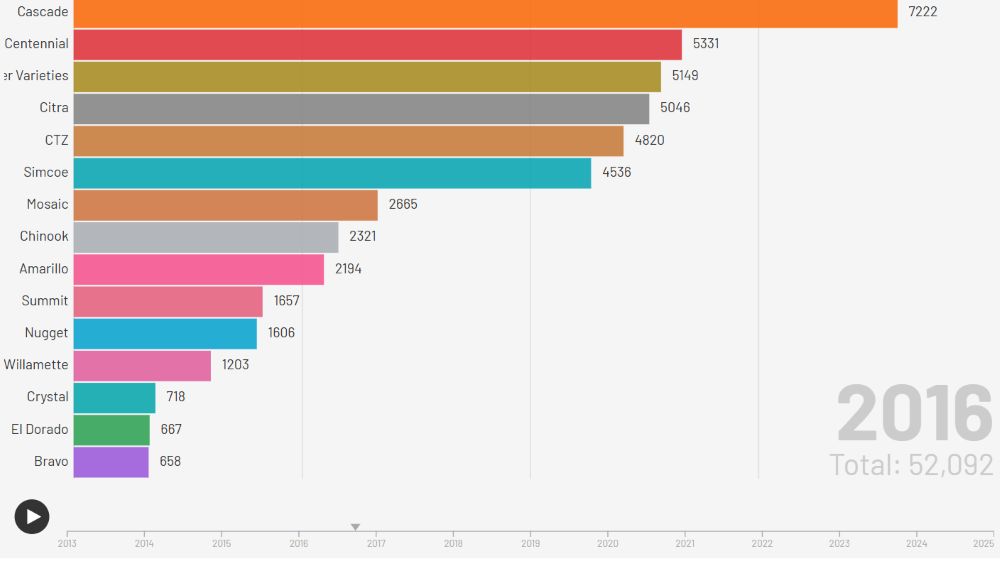
Jeff Alworth offered a bit of commentary here, and I think these three charts from the Hop Growers of America 2025 Statistical Report add context.
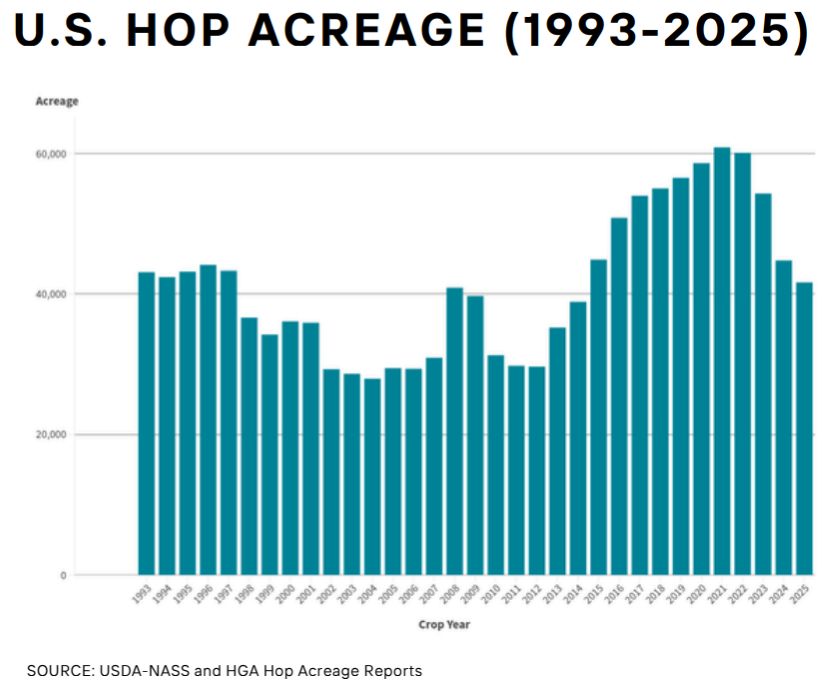
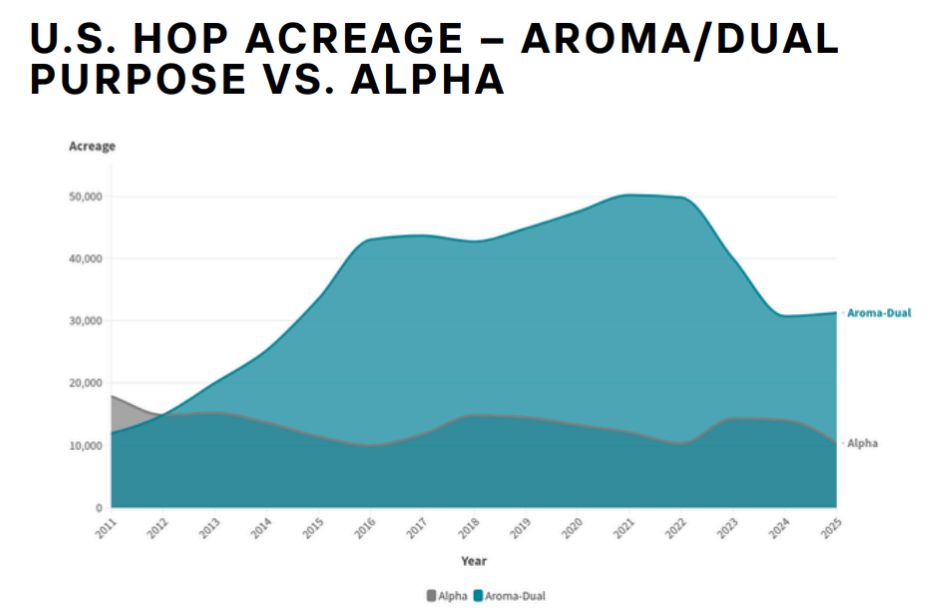
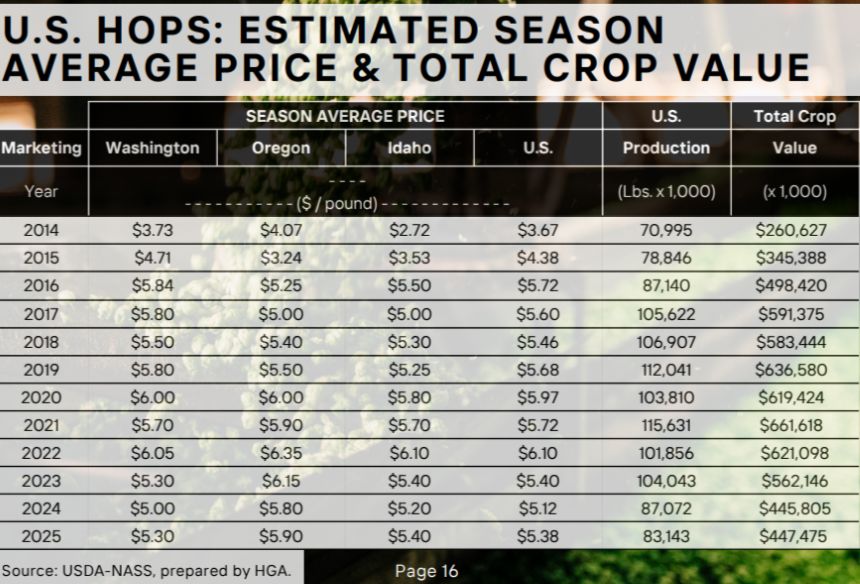
You’ll notice that the action Coleman charted took place as acreage was growing dramatically, growth fueled by demand for aroma and dual purpose hops (mostly the latter, which could be described as aroma on steroids). As a result, the average price of hops at the farm gate rose dramatically, mostly because those hops sell for more than alpha hops.
(Accounting for inflation, $3.67 price per pound in 2014 would be $4.99 in 2025 and the $2.6 million value of the crop would be $3.5 million today. Looking back to 2011, when the balance between demand for aroma and alpha began to shift, the average price per pound was $2.77, and the total crop value $203 million.)
DANK OUTTAKE: THE HEMPEROR HPA
Brewing Industry Guide recently posted a story I wrote about many things “dank.” It gave me an excuse to talk with Avery Gilbert, a smell scientist for the past 40 years and author of “What the Knows Nose.” Gilbert resides up the road in Fort Collins and together with Joseph DiVerdi at Colorado State University put together a cannabis aroma lexicon that is based more on sensory science than the average weed “aroma and flavor” wheel. It does not include “dank” because the word “seemed very broad and undefined.”
This amusing story didn’t really fit with what I wrote. Gilbert told me about somebody he knew who was a “big fan of weed” and therefore really enjoyed New Belgium The Hemperor HPA (2018-2020), which was brewed with hemp hearts (the seeds minus the shells) and dry-hopped with Simcoe and HBC 522. It contained now TCH or CBD.
This weed fan’s wife, on the other hand, did not care for the smell of cannabis. She made him drink the beer on the patio.
HOP QUIZ ANSWER
In the 12 months after Russell Schehrer and John Hickenlooper opened in Wynoop Brewing in 1988, Schehrer used only the five hops listed because he didn’t really have much more to choose from. His IPA recipe included Bullion for all of a 90-minute boil, more Bullion with 30 minutes left, and Willamette and Cascade five minutes before the boil ended. He dry hopped the beer in a serving tank with a blend of Cascade pellets and cones, plus French oak chips.