* What’s new?
* Wet hop loving cattle
* Cryo him a River
* For your reading & listening pleasure
Welcome to Volume 9, No. 11. When I started writing about varieties that are likely new to you I realized how much space they would take up. That’s why my plan to look more closely at the qualities in Cascade hops that brewers prize most highly will have to wait until April. As will a report on what I learned last week at the New York State Brewers Conference.
NEW FLAVORS, FAMILIAR FLAVORS
In alphabetical order . . .

– Huell Classic (5.7-8% alpha acids, 3.7-6.4% beta acids, 1.3 mL/100 grams total oil) has “the same herbal-grass, slightly spicy, and fruity aromas as traditional German hops, as well as the same gentle bittering quality.” Bred at the German Hop Research Center, Huell Classic is a daughter of Hallertau Tradition and an experimental Hüll male. Stepping back more generations, the male and female ancestors are genetically related to Hallertau Mittelfrüh and several also have Saaz genes in their background.
In advance of a commercial release of the hop this year, beers were brewed with her in both Germany and the U.S. The results were posted in The New Brewer (Nov-Dec 2025). In Germany, test batches were hopped with Herkules for bittering and finished with either Mittelfrüh or Classic for aroma. Although lab analyses indicated small differences, sensory panels did not detect any.
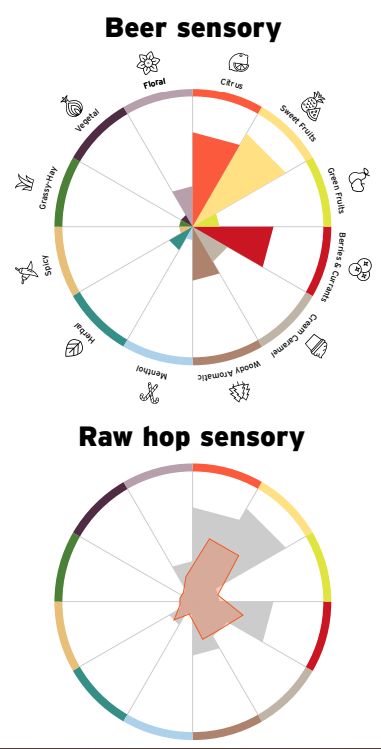
– Luna (13.2-15% alpha acids, 7.5-8.2% beta acids, 1.9-2.5 mL/100 grams total oil) comes with a nifty video. A press release states, “Luna seemed like the obvious choice for a hop that is distinguished by lush mango, dark berry and spicy citrus characters, alongside a high polyphenol content that elevates the flavour profile and mouthfeel.”
HPA suggests that a late whirlpool addition of 1-2g/L (0.4-0.7lb/bbl) accentuates spicy citrus characteristics, which can present as marmalade when interacting with darker malts. A dry hop of 4-10g/L (1.3-3.3lb/bbl) elevates the lush mango and dark berry character.
Back in 2018, HPA-033, as she was known before being commercialized, was one of nine experimental hops Mike Karnowski at Zebulon Artisan Ales brewed beers with for a talk he invited me to give at his brewery north of Asheville, NC. Several attendees marked it as their favorite and better than HPA-016, which became Eclipse. Descriptors included citrus, orange, tangerine, lime, delicate, and berry. Others mentioned “resinous west coast” qualities and “dank” notes as the beer warmed. One provided a potential name: “Vampire Sedator.”
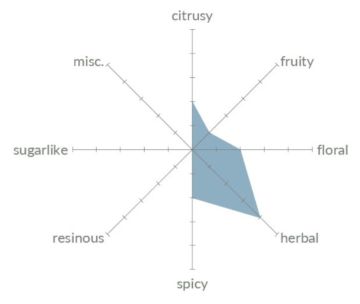
– Nobella (7-9% alpha acids, 5-6% beta acids, 1.2 mL/100 grams total oil) from Hopsteiner “combines a classic, traditional noble hop flavor with consistent alpha acid levels and reliable performance under today’s climate conditions, bridging tradition and future requirements in aroma hop breeding.”
An article headlined “The next generation of aroma hops” emphasizes Nobella’s agronomic improvement over European landrace varieties (known in some quarters as “noble”) as well as efficiency in the brewhouse. Granted, the spider graphs for Huell Classic and Nobella focus on different attributes, but notice herbal on both. That seems to be something of a marker for “noble-like” cultivars.
Hopsteiner will increase Nobella acreage five-fold in 2026. Although the immediate focus is on the German market, the company is putting samples from the 2025 harvest in the hands of key US customers. “There is interest,” says Doug Wilson, vice president sales and marketing.
– Ramosa is the latest from the Segal Ranch in the Yakima Valley, following Tangier, Zumo, and Anchovy. The name was chosen to honor Martin Ramos, the farm manager and breeder at Segal. It is derived from Latin and Spanish roots meaning “branch” or “full of branches,” a tip of the cone to its genetic lineage. Only a few breweries have been able to trial Ramosa. Alex Cordeiro at Tree House Brewing describes “juicy pineapple character, complemented by equally expressive notes of mango smoothie and background notes of freshly cut melon.”
– Rhapzody (13-14% alpha acids, 4.5-6% beta acids, .8-1.3 mL/100 grams total oil) is available from Clayton Hops in New Zealand. Clayton promotes her “intense tropical, passionfruit and pineapple character. Can be used both on the hot side and as dry hop in a variety of styles targeting a fruit forward hop profile.” Noteworthy: rich in 3s4mp precursors.
HOP TRIVIA
Rather than trying to turn this fun bit of history I wanted to share into a quiz, we’ll go with trivia this month. The hop quiz will return next month. In “Hops: Their Cultivation, Commerce, and Uses in Various Countries” (1877), P.L. Simmonds in 1877 writes:
“A farmer in the north of France, having been driven by the scarcity of fodder to try to make use of whatever fell in his way for feeding his cattle, proved that hop leaves were a valuable element of food for cows when mixed with other substances. He found that whenever he gave them hop leaves he always obtained more milk and his cows throve better than usual. The leaves must be used as soon as they are plucked, for the cows object to them when dried by the sun.”
FOR CRYO-ING OUT LOUD
Last month, John Duffy (The Beer Nut) in Ireland wrote, “I can’t help wondering if these (proprietary hop products) actually enhance the beers in any real way. I’ve certainly never identified any pattern among them: which ones to look out for and which ones aren’t worth the paper their patents were filed on.”
For a post headlined “Cryo me a River” (which I took as license to be silly myself) he compared a batch of Big Bangin’ IPA from Rye River Brewing made with Cryo Fresh Wet Hops from Yakima Chief Hops with the standard version. Take a moment to read what he learned. For those who don’t, a quick summary:
“The stand-out lesson is that standard Big Bangin’ from my local Tesco is world class in the aroma stakes” and “The cryo stuff does enhance the taste, but not hugely. Importantly, it doesn’t enhance the hop flavour, just the bitterness. My main takeaway here is a new appreciation for standard Big Bangin’. Turns out there’s not much that even the boffins at Yakima Chief can do to improve upon it.”
Given that some breweries have made Cryo, Incognito, HyperBoost, Amplifire, Quantum, etcetera marketing terms it is understandable to question their actual. However . . . I vividly remember the first beer I had made with Cryo Fresh four years ago (the product was called YCH 301 Trial at the time). It was from Single Hill Brewing in Yakima and it was spectacular.
Among other things, these products have been designed to ramp up the intensity of flavor and aroma. But they also can boost efficiency (don’t turn up your nose, that’s do-able without diminishing quality and may lower the cost of a beer). And they may increase shelf life. All when used skillfully, of course. On the downside, they can be foam negative. There’s much to consider, including what an Irish blogger had to write.
GET READY TO CLICK
Kilning with smoke-affected air impacts the chemical and aromatic qualities of Cascade hops. Cade Jobe presented much of the information in the paper at the American Hop Convention. My apologies, because I am a little late sharing this link, and now most of the content is behind a paywall. However, the summary provides a good sense of what researchers are learning about a climate change related challenge that is not going away.
Monohon hops. Where did this hop Big Block Brewing in Washington used to in brewing Monohon Lager come from? What might her heritage be? How was she saved? This story answers some, but not all, the questions.
Inside hop selection. John Holl tags along with representatives from Sierra Nevada Brewing on “a hop-fueled sensory journey.”
The evolving joy of craft beer and hops. I took plenty of notes during this webinar that included Patrick Raasch from Sun River Brewing, Sam Richardson from Other Half Brewing, and Brendan McGivney from Odell Brewing. And anytime I link to brewers singing the praises of Chinook I am going to do that.
I’ve been reading up on Huell Classic and Nobella, both seem interesting. Especially the former with the very low COH (19%) and Caryophyllene/Humulene ratio (0.17). Linalool seems to be optimised for more than previous generations of German aroma hops, Aurum also has a quite a high level.