* GABF category promotes newest public hop
* America’s hop fields continue to shrink
* Global outlook
* Hop Profile: Brewer’s Gold
Welcome to Vol. 9, No. 2. Stop me if you’ve heard this one before. Acres of hops strung for harvest in the Northwest states of Idaho, Oregon and Washington were down from last year. Not a shocker. Acreage has shrunk from a peak of 60,872 in 2021 to 42,231 in 2025. The surprise was that Citra acreage increased in all three states. Details after a bit of funs news about special treatment hop newcomer Vera will receive at the Great American Beer Festival.
GOING FOR GOLD WITH VERA
The result is not totally guaranteed, because beer judges have been known to do strange things like not awards medals. However, you can feel pretty confident betting that a beer brewed with the just named hop Vera will win a gold medal at the Great American Beer Festival. The Brewers Association has announced that it has created a special category for 2025 only, featuring beers brewed with Vera (formerly known as W1108-333 or HRC-003). They need not be single hop beers, but they must highlight the distinctive character of Vera, “which has been described as having tropical, stone fruit, and citrus character, reminiscent of a pineapple flavored Life-Savers candy.”
Vera is a product of the USDA-ARS breeding program, a cross between Brewer’s Gold and a powdery resistant male hop 64103M made in 2011 by Steve Kenny at Prosser Station, a Washington Station University facility. Although that program was shelved in 2015, promising experimental varieties were maintained. When a joint effort by industry participants (the Brewers Association, Hop Research Council, Hop Growers of America and others) revived the public program in 2018, W1109-333 was one of the cultivars that Hopsource identified as a brewer favorite.
Hopsource is a platform developed by DraughtLab to “identify public varieties, early in the breeding process, that show commercial promise for their sensory characteristics.” Brewers began using it in 2018 to provide feedback.
Vera was named for Vera Katherine Charles (1877–1954), an American mycologist. She was one of the first women to be appointed to professional positions within the U.S. Department of Agriculture. Charles coauthored several articles on mushrooms while working for the USDA. Although Charles was not involved in research related to hops, when brewers flavor a beer with Vera they may be reminded the hop comes from public supported research.
A press release announcing Vera is now available states the hop “represents one of several products to emerge from the large-scale effort to evaluate, release, and utilize beneficial germplasm from a former WSU breeding program to benefit the industry and the public.”
Research at Prosser resumed when Kayla Altendorf joined the USDA staff in 2020. At the time, the facility was in disarray. She cleaned it up, organized what was on hand, and has since expanded breeding stock. That includes, for instance, males resistant to powdery mildew that enter the public domain and become available to any breeding program. Another facet of public hop research that should not be overlooked.
US HOP ACREAGE DOWN 31% SINCE 2021
Now, what about demand?
The USDA forecast for hops strung for harvest in 2025 is 42,231 acres, down six percent from last year’s final harvested total of 44,793 acres and 31 percent since 2021 (60,872 acres). After much larger acreage reductions in 2023 and 2024, it might appear the market for hops is closer to equilibrium. It should be doable. Look at Centennial or Amarillo, both of which went through corrections earlier.
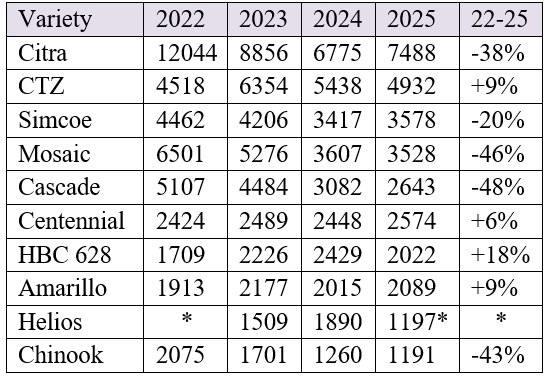
Remember that two years ago at the American Hop Convention, John I. Haas CEO Alex Barth estimated that farmers in the Northwest needed to reduce acres of hops strung for harvest by 10,000 in 2023. And the next year his successor, Tom Davis, said, “We took out 9,000 acres last year and it didn’t dent surplus, and that’s what is the painful part for all of us here. We have grown an industry very large, but it was more than it needed to be.” The annual interest being paid on unsold hops in storage was eating the industry alive.
That farmers will harvest 10.5 percent more acres of Citra in 2025 than 2024 — after reducing 44 percent in the previous two years — and that Simcoe and Mosaic seem to be finding balance might indicate excess inventory is close to being sufficiently depleted. If demand holds up.
A few other observations from the report:
– Washington farmers strung 334 acres of Krush (formerly HBC 586), which was named shortly before the 2024 harvest. On the one hand, that seems relatively conservative. On the other hand, those are almost as many acres of Strata — 338, down 41 percent from 2024 and 70 percent from 2022 — that Oregon farmers expect to harvest.
– I once suggested that Talus from the Hop Breeding Company, Eclipse from Australia and Nectaron from New Zealand would be contending for hop Rookie of the Year in 2021. In terms of acreage, Talus broke to the front. Farmers reported harvesting 423 in 2022. The total dwindled to 95 just last year. The USDA report indicates growers have strung 492 acres (more than Cashmere [181] and Comet [194] together, even though each is up this year). From possible Rookie of the Year to Comeback of the Year?
– Cashmere and Comet were among the varieties Crosby Hops listed as endangered after the 2024 harvest. Mount Hood was among the others, so fans will be happy to see that although Oregon acres decreased from 142 to 132, Washington farmers reported 55 after withholding information in 2024. The future of Zappa, Ahtanum and Triumph is not as clear. It is worth noting that there are 4,321 acres listed under “other,” avoiding disclosure of individual operations. Also, many farmers outside the Northwest have embraced Triumph.
– About the asterisks and Helios. The USDA withheld how many acres are strung to avoid disclosure of individual operations. However, earlier this month, global merchant Hopsteiner posted its own survey of expected acreage. Hopsteiner owns the rights to the proprietary hop and grows it on its Washington farms, so I expect their estimate of 1,197 acres is a pretty good guess.
GLOBAL OUTLOOK
A market report released at the IHGC economic commission meeting late last month estimates that after reducing hop acreage by about 4,600 hectares (11,300 acres) in 2024 farmers will cut another 7,000 acres worldwide in 2025, to about 132,000. That estimate was based on a forecast that reduction in the United States would be 4,000 acres, rather than the 2,500 reported by the USDA.
“Even with an average crop and average alpha acid contents, this would continue to exceed demand,” the statement says. “The global hop market remains a classic buyers’ market. Contract coverage for raw hop purchases is sharply declining after the 2025 and 2026 harvests, facing more than sufficient availability across almost all hop varieties. The ongoing low spot market prices are putting sustained pressure on the contract market. Breweries are expecting favorable purchasing conditions.
“This stands in stark contrast to the increasing challenges faced by the hop industry. Rising costs throughout the value chain — along with the unpredictable risks of yield losses due to accelerating climate change — are putting financial strain on all market participants. Contracts concluded at current low levels jeopardize future investments essential for maintaining hop production.”
HOP PROFILE: BREWER’S GOLD
I just realized I haven’t officially profiled Brewer’s Gold. Several months ago, I recounted the origin story of Russian River’s Bring Back Brewer’s Gold for Brewing Industry Guide. The history really begins in 1906, so let’s get right to the heritage (taken directly from “For The Love of Hops,” but edited for length).
Heritage. In the spring of 1917, Ernest S. Salmon, a professor at Wye College, 60 miles east of London, placed a single female hop in hill 1 of row BB of the Wye nursery. Salmon designated all his breeding material based on its position in the hop garden. He labeled row A, B, C, and so on; then AA, BB, CC. When he planted that wild Manitoban hop in hill 1 of row BB its name became BB1. BB1 matured early in the summer of 1918, flowering in July. In the fall, Salmon harvested the seeds the cones produced.
Salmon took charge of hop breeding at Wye in 1906. In 1917 he presented a paper to the Institute of Brewing in London that revealed his main objective in breeding was to combine the high resin content of North American hops found growing in the wild with the aroma of European hops. This plan would take hops in a new direction.
BB1 did not take to its new environment, dying during the winter of 1918-1919, but Salmon raised hundreds of offspring in a greenhouse. He planted some of them out in the Wye nursery in 1922, including one each in hills C9 and Q43. Because a previous plant in C9 had shown promised, he named the next one C9a. By 1925 that plant attracted attention for the richness of its cones.
Although brewing trials were mixed, Salmon made Brewer’s Gold available for commercial cultivation in 1934, and in 1938 released its sister, Q43, calling it Bullion. Neither received wide acceptance in England, but both were moderately successful in the United States.
In 1972, the year farmers began to plant a significant amount of Cascade, Oregon growers still harvested 1,297 acres of Bullion and 578 of Brewer’s Gold. However, by 1989 — when Russian River Brewing cofounder Vinnie Cilurzo first used Brewer’s Gold as a homebrewer — acreage had reached to such a low level that it didn’t show up in harvest reports.
However, by then Brewer’s Gold was established as an important contributor in breeding new varieties.
Josh Havill, a postdoctoral researcher at the University of Minnesota, identified 118 varieties (now 119, including Vera) that are descendants of BB1. Most are offspring of Brewer’s Gold, including cultivars valued for their alpha — such as Herkules, Magnum, and Nugget — or for their aroma, such as Centennial, Chinook, Denali, Sorachi Ace, and Citra.
The basics: 8-13% alpha acids, 3.7-6.8% beta acids, 1.8-2.9 mL/100 grams total oil.
Aroma qualities: In the BIG story (behind a paywall), Cilurzo says that although Brewer’s Gold adds an “amazing fruitiness” to a hazy beer, he appreciates that the hop isn’t totally modern. “I like that it has a little more coarseness” in the bitterness, he says. The sweet, musky black currant (or ribes) character brewers described nearly a century ago becomes more apparent as the beer ages.