* Here comes Dolcita
* German hop production shrinks
* Beyond Saaz
* Drought conditions in England
* Counting hops
* Oregon Hop Festival
* Hop Source Sept. 23-25
* New Lupulin Exchange tool
* Reference material
* Listen here
Welcome to Vol. 9, No. 4. As the list right above indicates, there’s plenty of information to pass along this month, which means keeping everything brief. I’ll start with something I learned in Argentina earlier this month. How do you say hop burn in Spanish? Hop burn. Same in Portuguese as well.
DOLCITA
From the press release: “Hop Breeding Company (HBC) is proud to announce the official commercial release of Dolcita brand HBC 1019, a new and innovative hop variety designed to meet the high expectations of brewers and beer lovers around the world. Created in 2016 using traditional breeding methods and HBC’s proprietary breeding stock, Dolcita is one of the fastest hops ever brought to market by HBC.”
I posted more at the newsletter website, and also wrote about Dolcita and other newcomers for Brewing Industry Guide. You can find even more at the John I. Haas and Yakima Chief Hops websites.
FROM GERMANY

As you can see, there is a new Hallertau hop queen (the Tettnang region has a queen of its own). She was crowned last week at a fest party that signals the beginning of harvest. Unlike in the United States, where we must wait until December to learn how many million pounds farmers harvested, the German Hop Growers Association publishes an official estimate for the crop (scroll down for English). Farmers are expected to produce 41,235 metric tons (about 90.7 million pounds and likely more than the U.S. crop), 11 percent fewer than 2024. Growers cut acreage by 6.5 percent and yields were adversely affected by a lack of rain until mid-July and further reduced by disease and pest pressure.
A press release indicates that 44 farms ceased operations, meaning the number of growers has slipped below 1,000. It concludes: “Hop growers are reacting to poor prices and limited marketing opportunities by reducing acreage. The short-term outlook is not rosy: Given declining beer consumption, a further decline in hop demand is to be expected. The result will be continued pressure on prices and a further reduction in hop acreage until supply and demand are restored.”
FROM THE CZECH REPUBLIC
Evan Rail writes, “If Saaz represents the Czech Republic’s hop-growing history, the other 18 percent just might be its future. The country’s significant hop industry—the world’s third-largest, by acreage—currently includes 28 registered varieties of chmel. Almost all of those are Saaz descendants, which often showcase some of its characteristics as well as compelling qualities of their own.”
The challenge is to get more brewers to give these other varieties a try.
FROM ENGLAND
The latest: “Drought conditions could cause a hop shortage, threatening a major part of the farming landscape in Herefordshire and Worcestershire, farmers say. Hop farmer Ali Capper from Suckley, on the border between the two counties, and said this year’s yield could be down by as much as 50 percent. ‘We’ve got a crop that is looking fairly unhappy,’ she said, adding she was likely to make a loss due to the shortfall.”
English hop production has shrunk to a level that this news won’t affect the world hop market. But it sounds bad for brewers committed to using those hops.
COUNTING HOPS
I didn’t mean to pick on the person who sent a press release that crowed, “Oregon Retakes No. 2 Spot for U.S. Hop Crop.” But I sort of did last week when I put together some numbers posted at Appellation Beer. Yes, Oregon farmers strung more acres for harvest than Idaho farmers this year. That doesn’t mean they will harvest more hops. Nor is it totally great news. Acreage decreased from 5,635 acres to 5,421. That said, photos that growers have posted on Instagram from harvest are looking awfully good. I feel the need to check out a few farms in person.
OREGON HOP FESTIVAL
Sorry, I didn’t put together a list of fresh hop festivals this year. Last year’s lineup should give you an idea where to look this season. And the Oregon Hop Festival at TopWire Hop Project next Saturday and Sunday (Sept. 6-7) appears to be a good way to get in the mood. (Although it is a little early to expect too many fresh hop beers.) A few highlights:
– Guided tractor tours through the hop fields and behind-the-scenes access to Crosby Farm’s processing facilities.
– Two anniversary beers brewed with estate-grown hops: a TopWire West Coast IPA brewed with CGX Nuvo Centennial and a Deschutes Brewery 125th Anniversary Ale. (It’s the 125th anniversary for Crosby Farms.)
– Hop-forward beers from more than 20 breweries.
– A hop sensory station with freshly picked hops. Includes a friendly pairing competition.
YOUR NOSE IS WELCOME HERE
The Brewers Association’s annual Hopsource sensory evaluation will take place Sept. 23-25 in Yakima. Smelling occurs daily from 9 a.m to 5 p.m. at Yakima Valley Hops. During the event, brewers and industry professionals visiting Yakima for hop selection will have a chance to assess up to 30 hop varieties. The BA encourages visitors to participate in multiple sessions, as the varieties sampled will change every day and every morning and afternoon. These varieties are currently under consideration for advancement in the United States Department of Agriculture (USDA) public hop breeding program.
COOL NEW TOY
There is a good chance you won’t have access to the LExIndex tool at Lupulin Exchange, because it is available to active members only. But it is quite nifty. Introducing it to members, founder John Bryce listed a few things it can do.
– Track how prices and inventory levels have changed over time for any hop variety, product type, or crop year.
– Visualize historical price decay by variety.
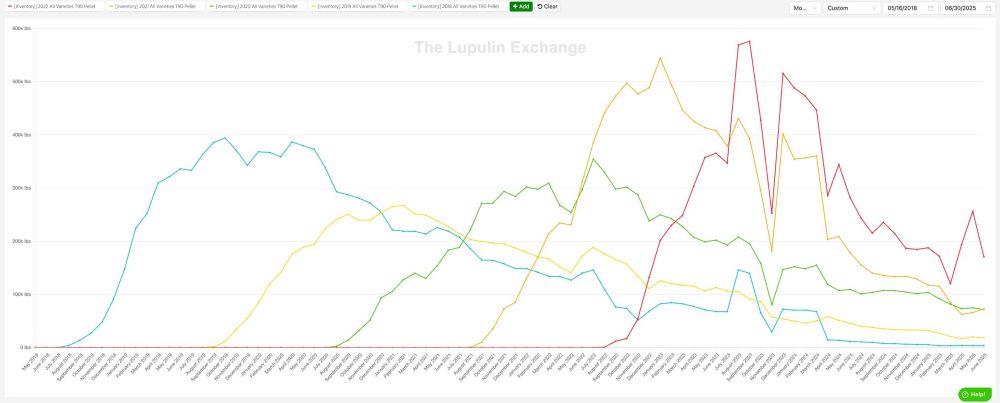
– Overlay inventory depletion patterns (shown here) by crop year to spot early signs of oversupply, tightness, or shifting demand.
This adds transparency for those buying (and selling, for that matter) hops. That is a good thing. But you know what adds transparency for growers and results in a more stable hop market? Contracts. There are good reasons for brewers to be buy hops on the spot market. Lupulin Exchange serves a need, but it is just one option.
BARTHHAAS REPORT
As I predicted many takeoffs and landings ago, the BarthHaas Report 2024/2025 became available in late July. The tagline repeats a message we all wish weren’t true: “Hop industry is still fighting oversupply.” You may download the report here.
LISTEN HERE
– Last month, I mentioned a panel discussion at the Mighty Fine IPA festival in Duluth, Ga., about the evolution of IPA and Pizza Port Swami’s in particular. The chatter between Tim Wallen, Steve Burchill and Jeff Bagby is available now at Drink Beer, Think Beer.
– Less than 24 hours after I arrived home from Argentina I chatted with Brad Smith about new hop varieties. Yes, that is offered as an excuse for a certain amount of mumbling on my part.