* New Zealand flooding
* What tools to use & when
* Hop Profile: Talus
* Good listening
Welcome to Vol. 9, No. 3. The BarthHaas Report 2024/25 will be published next Tuesday (July 22). The release always provides useful information about the previous global harvest and hints about what to expect in the coming months. I’ll be a few days into the beginning of a stretch of travel during which I’ll be home eight out of 31 days. That’s why you are getting this now and a summary of the report will have to wait until the August dispatch.
DISASTER DOWN UNDER
What’s going on in the Tasman region of New Zealand is what they call a breaking news story. At the end of last month, rain hammered the area. Here’s part of the message that Brent McGlashen posted on Mac Hops Instagram feed:
“Statistically and visually, we hit above the 1 in 100-year flood level, with also highest ever recorded river flows in a number of parts in the Motueka river. There were stopbank breaches in places, but luckily the Motueka township was a couple of feet away from near disaster with the high tide also causing issues.
“Both our farms have water everywhere, fences with damage and some debris scattered around, but we are fortunate compared to others who have had significant damage and loss due to the flooding. Was this predicted, well yes it was. Forecasters said over 200mm and we sure got that. We have had a wet winter and the ground can’t absorb more so it has to go somewhere.”
One hop farmer died as a result of the storm. Peter Lines was clearing flood damage from his property in Wai-iti, southwest of Nelson, when he was hit by a tree. This tribute on Instagram provides an idea of how important he was to the hop growing community.
Another round of rain arrived last week, leaving fields under water and dumping mud, gravel and sand on facilities that had just been cleaned up (or were still being cleaned up). Hayden Oldham from New Hoplands said “it’s back to the start. Everything we cleaned up has been spread back out and gone through sheds and gardens.” He said downed trees swept into fast moving water had taken down hop poles.
Reports indicate there are “months and months” of work ahead to restore infrastructure in region.
Remember, it is winter on the other side of the equator. It will be months before farmers begin puts hops to string and February before harvest begins. “Hops are real hardy and right now they’re asleep in the ground, so I am hopeful they won’t get too asphyxiated,” Oldham said, optimistically.
Merchants I checked with indicate they do not expect this will impact overall 2026 production, although there will be pain for some growers. “Most rested 25 to 30 percent of their area last year, so not hard to swing some of that back in,” McGlashen wrote.
Meanwhile, farmers know that weather is a part of working in agriculture. “(My father) has been going on for years about the big flood we’re due – it came! Not the worst we’ve seen in the Moutere Valley (apparently there’s still half a meter to go before it rivals the big one), but it’s possibly the biggest in my lifetime,” wrote Kem Eggers at Eggers Hops.
David Dunbar, managing director at Freestyle Hops, reports: “We’ve invested a good bit over the last five years in improving our drainage and resilience to these types of events, because we have a view that they are now a normal part of our weather. The ‘once-in-a-hundred-year’ storms seem to happen every other year now. We will continue to work on improving our drainage and stormwater management infrastructure, because unfortunately I don’t see the situation changing any time soon.”
HOP USAGE CHART
As I have written here before, reporting about new varieties or products can seem a bit awkward for me. I start to feel like a salesperson. Likewise, when I saw this chart that Yakima Chief Hops assembled, I thought, “Cool, this would be good to share, but sure looks like an ad for YCH.”
I am counting on you to understand that the information is equally useful even if you are brewing with hops and hop products from other vendors. Notice that a product name is followed by a product description. For instance, Hopsauce from The Hop Guild in New York and Incognito from John I. Haas are, like YCH’s Dynaboost, flowable extracts designed for use in the whirlpool.
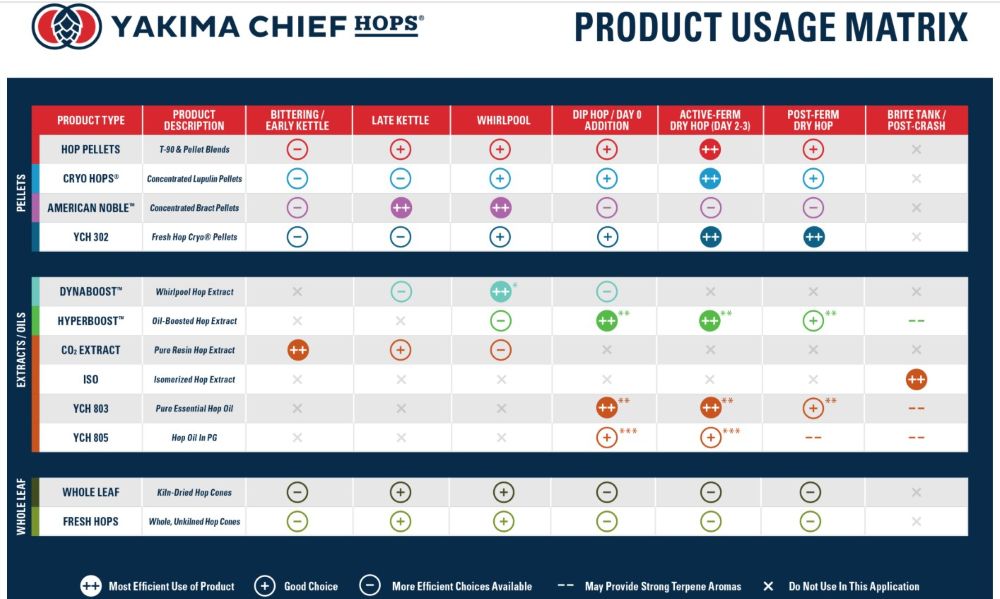
A YCH post last month provided details about the matrix and each of their products.
HOP PROFILE: TALUS
Last month I mentioned the surprising increase in acres of Talus strung for harvest, a bump from 95 acres in Washington up to 492. Those acres produced 177,000 pounds of Talus in 2024. If the additional acres are as productive (first year plants do well in the Yakima Valley, but not that well) then 917,000 pounds could be available in 2025. That is twice the production of Sabro and comparable to Ekuanot, two earlier releases from the Hop Breeding Company, a partnership between Yakima Chief Ranches and John I. Haas.
The name, Talus, is a nod to the talus slopes found in the Yakima Valley. She is a daughter Sabro. “We were getting very significant pull (demand),” Jason Perrault, CEO and hop breeder for Yakima Chief Ranches, said when she was named. “We’ve seen the impact it can have in a beer. Unique, but appealing. It was just time to give it its own identity.”
In 2018, I helped organize a tasting of IPAs made with experimental hops at Zebulon Artisan Ales north of Asheville, N.C. Mike Karnonski, who prefers brewing Ron Pattinson-inspired historic recipes, suggested and hosted the tasting. Breeders from both hemispheres sent hops. I’m not sure what made it more fun—that Karnowski made more IPAs for the tasting than he does the rest of the year or dealing with customs.
The lineup included two hops from HBC (692 and 630), two from Hop Products Australia (HPA-016 and 033), three from Charles Faram in the UK, and two from Hopsteiner (X04190 and X09326).
Six of those now have names, including Talus (HBC 692). The Faram hops became Godiva (already CF217’s working name at the time), Mystic (previously CF160) and Harlequin (CF212). Hopsteiner X04190 became Contessa. She is not an IPA hop, and served as something of a control. HPA-016 became Eclipse.
Those attending the tasting rated the IPAs 1 to 5 in six categories (floral, spicy/herbal, woody/earthy/resiny, citrus, vegetal and red/sweet fruits). These were not trained panelists, but they did their best and sometimes added interesting notes. (Such as from the participant who described HPA-016 as “vampire killer” and 033 as “vampire sedator.”)
Talus easily rated highest in both floral and citrus, even though she came up last in the lineup (by then alcohol and palate fatigue had kicked in). Pretty much every citrus-related flavor was described — lime, orange, lemon peel, lemongrass, pineapple, tangerine, grapefruit, you get the idea.
My two favorite notes for HBC 692 were “unicorn toes” and “Minty, resin, grapefruit, onion, minerals. The future with flying motorcycles instead of jetpacks.”
Heritage. As noted, Talus is a daughter of Sabro, known for her coconut character (a love-hate aroma that some describe as sun tan lotion). I remember being in Brazil the year after she was named and seeing so many piña colada beers.
The basics: 8.9-9% alpha acids, 8.3-10.2% beta acids, 1-2.2 mL/100g oil. Talus sits on the left end of the YCH “survivables” chart, meaning she is rich in compounds will make their way into finished beer even when added (relatively) early in the brewing process. That is because she is contains high amounts of 2 methlybutyl isobutyrate (a fruity ester, often perceive as apricot like) and geraniol, a key component in biotransformation.
Aroma qualities: Talus delivers the citrus, floral and woody character expected in “IPA hops,” but not with the punch in the nose associated with Sabro. “Sabro is such an expressive hop it is a challenge to use with other hops. It overpowers them,” said Jeremy Moynier, senior innovation brewing manager at Stone Brewing Company, when Talus was released. “692 seems cleaner. Lots of fresh fruit. It has a little more finesse.”
PODCAST TIME
– John Holl was at the Might Fine IPA Festival last month with his podcast gear. He moderated three panels himself and turned one over to me. Diane Gooding of Gooding Farms in Idaho, Liz Bauer of Garston Hops in New Zealand and Alex Nowell, Mallotone Beer Project founder and also a consultant for CLS farms, talked about, “How Craft Beer, and IPAs in Particular, are Changing the Hop Industry.”
I make it a rule never to listen to myself on podcasts, but you may want to, and to check out the other panels as the recordings are posted at All About Beer.
– Megan Twomey talks about the Latitude 46 breeding program on No Dirt No Flowers, and how it has evolved since the American Dwarf Hop Association was focused on, no surprise, dwarf hops.